AI Cost Estimation
 AI Project Scheduling
 AI Risk Assessment & Mitigation
 AI Labor Estimation
 Work Breakdown Structure
 Design for Manufacturing (DFM)
 Should Cost Analysis
 Price to Win (PtW)
 Total Cost of Ownership
 Design to Cost
 RFI, RFP, RFQ


Mastering Cost Risk with the CRED Model: A New Approach to Managing Uncertainty


New: SEERai by Galorath
With SEERai, teams move from raw data to estimates in hours instead of weeks. Every output is traceable, audit-ready, and designed to improve decisions across estimating, sourcing, and risk.
Introducing SEER by Galorath
SEER Overview →Galorath’s platform combines trusted cost logic with AI to deliver fast, structured estimates that drive better decisions from design through delivery.
AI use cases
See AI Use Cases →Essential use cases
See All Use Cases →Latest articles

Why Most ROI Models Miss the Real Value of Estimation

Trusted by leaders in the industry:

Manufacturers are running into the same wall again and again: rising costs, slipping timelines, and tools that no longer do the job. While production teams move faster and customer demands grow louder, cost estimation is stuck in the past.
This report is built on a foundation of carefully screened participants and thoroughly vetted data. Every response was subject to rigorous quality checks to ensure both reliability and relevance. The result is a set of insights that support critical business decisions with accuracy, authority, and practical value. The numbers show widespread frustration, low confidence, and growing urgency to modernize. Spreadsheets are still the default. Automation is rare. Many teams are being asked to hit targets without real-time data, integrated tools, or adequate training.
Expectations are rising faster than most manufacturers can keep up. Those that invest in better systems, stronger data, and internal expertise will be positioned to lead. Those that don’t will continue to lose ground.
Findings from the 2025 Manufacturing Estimation Report:
0%
of manufacturers say their initial cost estimates miss the mark
0%
of respondents still rely on Excel for cost estimation.
How Confident Are Teams in Their Estimates
0%
Somewhat confident
0%
Very confident
Integration Levels in
Estimation Systems
0%
say their cost estimation tools are fully integrated
0%
remain siloed
Automation is
Underutilized
0%
say they’ve automated more than 75%.
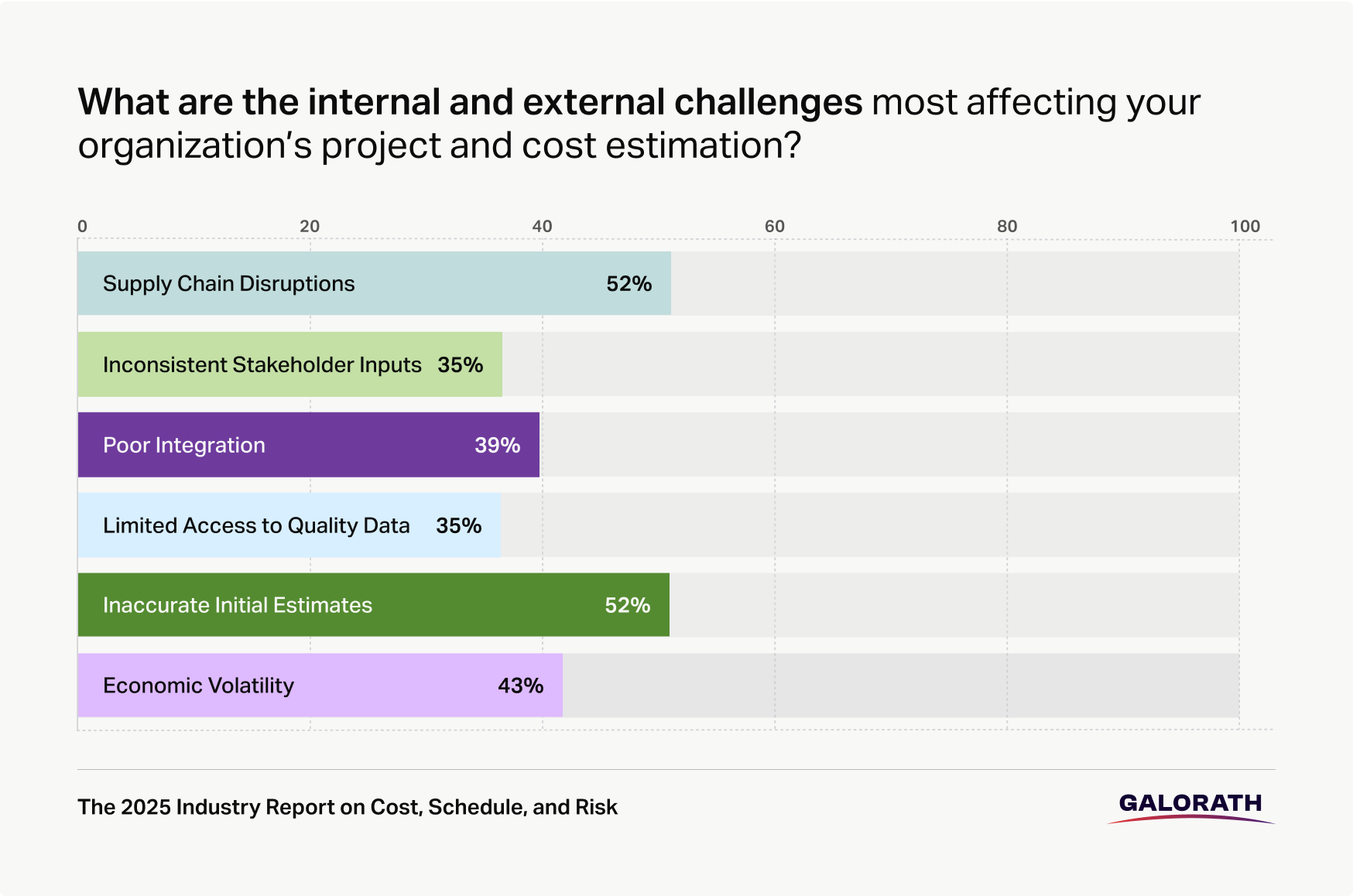
Nearly half cite economic volatility and limited data access as ongoing challenges.
The survey gathered perspectives from 180 senior and mid-level professionals across industries where cost, schedule, and risk estimation are mission critical. Participants were recruited through a custom process and verified through multi-layer identity authentication to ensure subject matter expertise. Each respondent completed the survey via a unique, single-use link with strict quality controls, fraud detection, and response validation protocols. This approach provides a reliable, third-party–verified view of how organizations are approaching project planning in today’s volatile environment.
Manufacturing has always demanded speed, accuracy, and adaptability. But in 2025, those demands are rising faster than most teams can keep up. Material prices fluctuate without warning, supply chains shift mid-cycle, and customers expect transparency in cost and delivery. Despite these conditions, many cost estimation processes rely on spreadsheets, delayed inputs, and informal workarounds, leaving teams vulnerable to change.
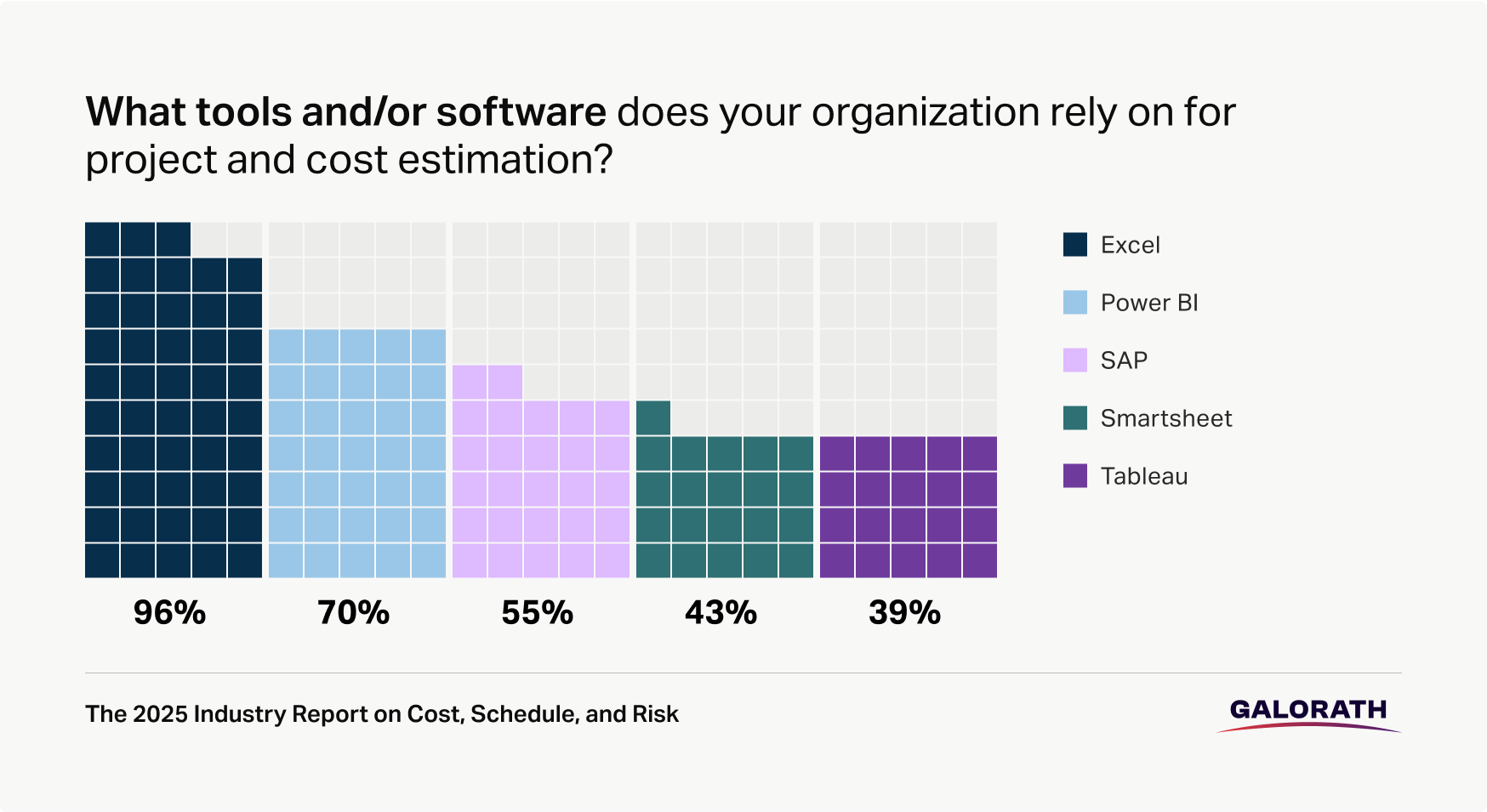
The data is clear: 96% of manufacturers still rely on Excel to manage cost estimation. Only 4% have automated more than three-quarters of their process. The result is avoidable errors, manual rework, and slower decisions. Estimation is no longer just a financial exercise, it directly impacts delivery timelines, profit margins, and customer satisfaction. To stay competitive, manufacturers need to modernize.

These five patterns point to internal friction that slows delivery, weakens planning, and increases project risk.
Fifty-two percent of manufacturers say their initial cost estimates are inaccurate. That means almost half of projects begin with flawed assumptions. These inaccuracies are not caused by lack of effort or ability. Instead, they are symptoms of outdated tools and limited access to real-time data.
Inaccurate estimates have cascading effects. When costs rise or timelines shift mid-project, teams scramble to adjust. Budgets must be reapproved, suppliers must be renegotiated, and schedules must be reworked. With better systems and inputs, many of these disruptions could be avoided.
What are the internal and external challenges most affecting your organization’s project and cost estimation?
0%
Inaccurate Initial Estimates
How often do your projects exceed their original timelines?
0%
Frequently
0%
Occasionally
How often do your projects exceed their original budget?
0%
Occasionally
0%
Frequently
0%
Very confident
Despite better tools being available, 96% of manufacturers still rely on Excel to manage estimation workflows. Spreadsheets are familiar but are not built for speed, collaboration, or integration. Version control problems, inconsistent formatting, and manual data entry all slow teams down.
Only 4% of manufacturers have automated more than 75% of their estimation process. Another 65% have partially automated between one quarter and one half of their workflows. That leaves most teams stuck with semi-manual processes that limit productivity and increase exposure to error.
Only 17% of respondents say they are very confident in the accuracy of their estimates. More than half are only somewhat confident. When teams don’t fully trust the numbers, they hesitate to act. That hesitation slows procurement, delays approvals, and weakens collaboration between departments.
Low confidence is not a people problem. It is a systems problem. Without reliable inputs and validated methods, teams cannot forecast accurately or explain their assumptions. Improving confidence requires better tools, clearer feedback loops, and support from leadership.
Estimation challenges are not just internal. Manufacturers are under pressure from unpredictable supply chains, economic volatility, and shrinking access to quality data.
In the survey, 52% of respondents pointed to supply chain disruptions and inaccurate initial estimates as top challenges. Another 43% cited economic volatility. Poor integration with project management tools was noted by 39%, while 35% highlighted limited access to quality data and inconsistent stakeholder inputs.
Manufacturing shows the lowest current adoption of AI for estimation though pilot activity is increasing. Another 39% say it is somewhat important. That suggests growing curiosity, but slow movement. Most teams see the potential but have not yet acted.
Concerns include transparency, implementation effort, and uncertain returns. But AI already supports common needs like scenario modeling and predictive risk analysis. Teams that start small with clear use cases can reduce effort, improve accuracy, and build momentum for broader change.

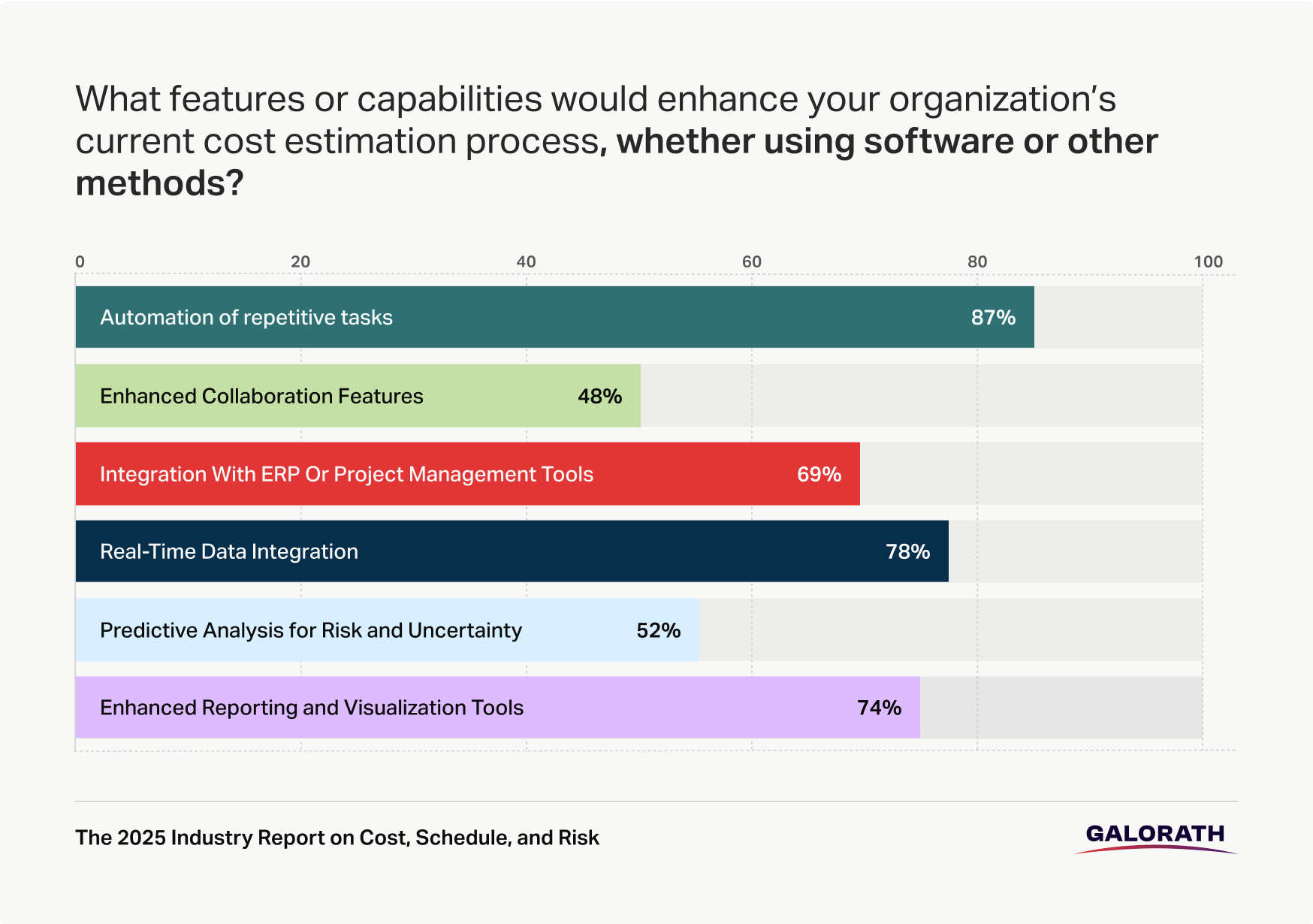
Manufacturers are clear about what would help. Eighty-seven percent want to automate repetitive tasks. Seventy-eight percent want real-time data integration. Seventy-four percent want improved reporting and visualization. Forty-six percent want tools to benchmark against past projects.
These are not just preferences. They are the foundations of modern estimation. Better tools would reduce rework, help teams communicate more effectively, and speed up decision-making across departments. In a fast-moving market, that capability matters.

Audit your estimation workflow
Identify where manual entry, version control problems, or delays are slowing your team. Focus on handoffs between systems and rework loops that repeat each cycle.

Benchmark confidence across teams
Survey teams to understand how much they trust current estimates. Use this insight to prioritize training, improve visibility, or explore better tools.

Automate one high-friction task
Choose a process that consumes significant time and repeat it with automation. For example, use a tool to auto-fill inputs from past projects or run “what-if” scenarios based on commodity pricing.
This report is part of a deeper look at how cost, schedule, and risk planning are evolving. Access the full 2025 Industry Report on Cost, Schedule, and Risk to see where the biggest gaps and opportunities exist.
Access The Report