AI Cost Estimation
 AI Project Scheduling
 AI Risk Assessment & Mitigation
 AI Labor Estimation
 Work Breakdown Structure
 Design for Manufacturing (DFM)
 Should Cost Analysis
 Price to Win (PtW)
 Total Cost of Ownership
 Design to Cost
 RFI, RFP, RFQ


Mastering Cost Risk with the CRED Model: A New Approach to Managing Uncertainty


New: SEERai by Galorath
With SEERai, teams move from raw data to estimates in hours instead of weeks. Every output is traceable, audit-ready, and designed to improve decisions across estimating, sourcing, and risk.
Introducing SEER by Galorath
SEER Overview →Galorath’s platform combines trusted cost logic with AI to deliver fast, structured estimates that drive better decisions from design through delivery.
AI use cases
See AI Use Cases →Essential use cases
See All Use Cases →Latest articles

Why Most ROI Models Miss the Real Value of Estimation

Table of Contents
A scope baseline defines the project’s boundaries, deliverables, and required work. It includes the project scope statement, work breakdown structure (WBS), and WBS dictionary, and serves as the reference for managing project scope.
This article explains what a scope baseline is, who creates it, its requirements, and its role in scope management. It also covers its importance, the components of the baseline, change control, and its use in project integration. We’ll walk through how to develop a scope baseline, its application in different industries, and provide an example.
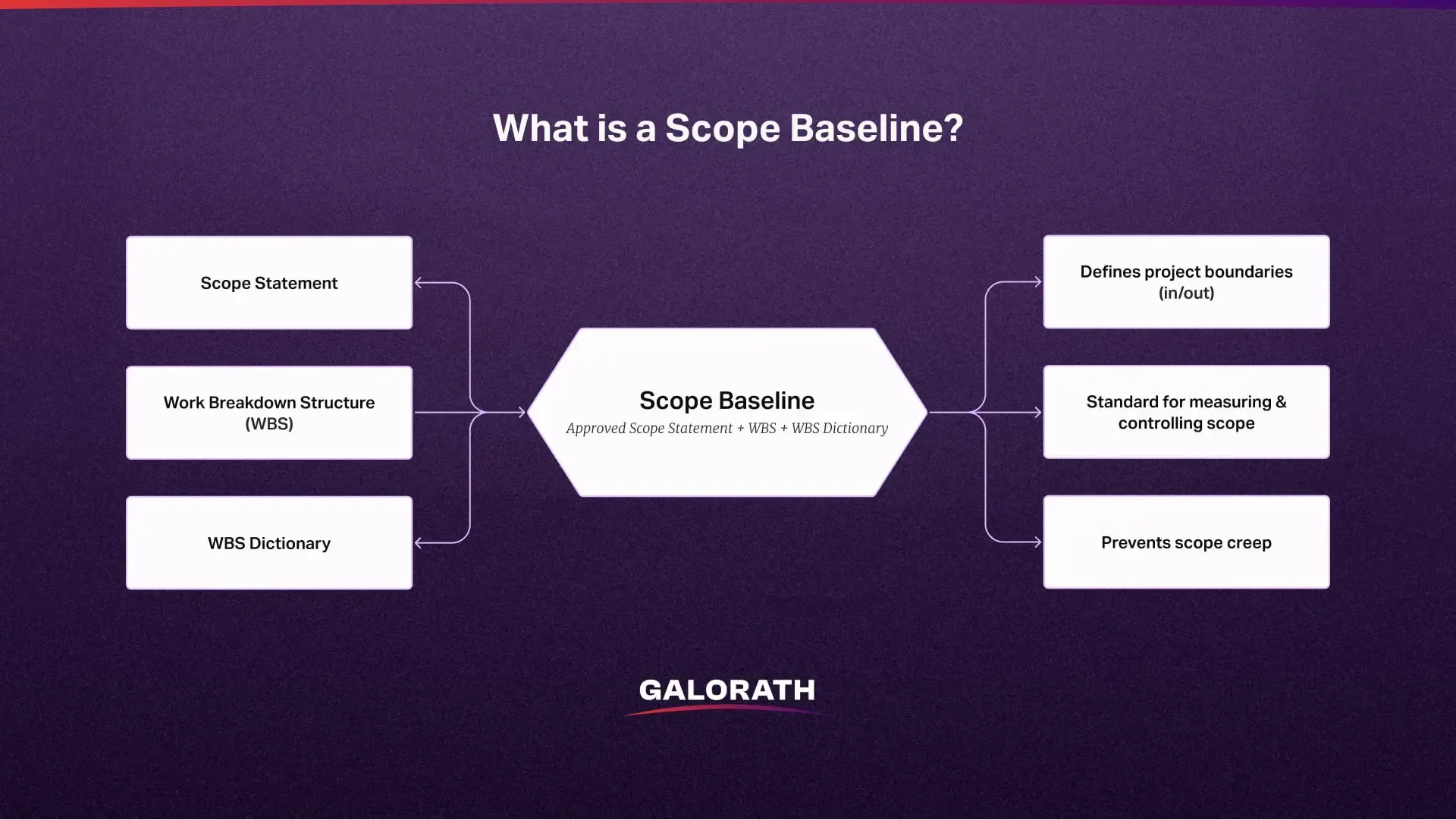
A scope baseline is the approved version of the project scope statement, work breakdown structure (WBS), and WBS dictionary. It serves as the standard to monitor and control the scope throughout the project.
According to the Project Management Institute (PMI, 2017), the scope baseline “defines the scope, including the boundaries of the project” and acts as a “standard for measuring and controlling scope” throughout the project.
The scope baseline is part of the overall project baseline, which includes time and cost baselines. It helps manage scope effectively, track performance, and prevent scope creep. According to Kerzner, scope baseline ensures that the project remains focused on its intended goals, preventing unnecessary additions to the project scope.
The scope baseline is essential for scope management because it defines what is included and excluded from the project.
According to Kathy Schwalbe in “Information Technology Project Management”, the scope baseline serves as the reference point for any changes and provides a clear outline of what is and is not part of the project. In the following image, we can see how is scope baseline connected with the scope basement, wbs and wbs dictionary, and for what it is used for.
The project manager, along with the project team and stakeholders, usually creates the scope baseline. According to the Project Management Institute (PMI, 2017), the process involves gathering input from stakeholders, defining project deliverables, and breaking them down into manageable components. This process ensures that all key aspects of the project are covered and understood by the relevant parties. The project stakeholders typically approve the final version. As Harold Kerzner explains, the stakeholders’ approval ensures that the scope baseline reflects the agreed-upon project deliverables..
To create a scope baseline, the following inputs are needed:
These inputs guide the creation of the scope baseline, ensuring it aligns with project goals.
The scope baseline is used for several key purposes in project management, such as proper scope control, change management and effective communication with stakeholders.:
Scope baseline acts as the reference point for measuring and controlling the actual project work against what was initially planned. Any changes or deviations from the scope can be tracked, helping to maintain project focus.
The scope baseline is essential for managing changes. Any proposed changes to the project scope must be compared to the approved baseline, assessed for impact, and formally approved before being integrated into the project.
Scope baseline provides a clear, consistent understanding of the project’s scope among all stakeholders. This helps prevent miscommunication and rework and ensures everyone is aligned on the project’s objectives and deliverables.
The scope baseline is critical for several reasons, as it provides the foundation for managing project scope and aligning stakeholders’ expectations. By clearly defining what’s included and excluded from the project, it ensures the project stays on track and within its agreed-upon limits. According to Jeffrey Mochal in “Lessons in Project Management“, “defining scope allows you to ensure you have an agreement with your sponsor on the box your project is responsible for”
Below are the key reasons why the scope baseline is essential:
The scope baseline helps prevent scope creep, which is the uncontrolled expansion of the project’s scope without adjustments to time, cost, or resources. By referring to the baseline, any changes to the scope must go through a formal change control process, ensuring that the project remains within its original objectives and avoids unnecessary delays or additional costs.
A clearly defined scope baseline minimizes the risk of miscommunication. It ensures that all stakeholders have the same understanding of the project’s deliverables, boundaries, and objectives.
By setting clear expectations from the start, the scope baseline ensures that everyone is aligned and helps to keep the project within the defined scope..
The scope baseline plays a key role in ensuring that the project’s scope aligns with stakeholder expectations. It serves as a reference point to confirm that the work being done aligns with what was agreed upon. This alignment helps to manage stakeholder satisfaction and ensures that the project’s goals remain relevant to the stakeholders’ needs.
The scope baseline is the foundation for managing changes throughout the project. Any scope adjustments need to be formally evaluated, and the impact on the project’s time, cost, and resources must be assessed.
The scope baseline ensures that any changes are properly documented and approved, maintaining control over the project and minimizing disruptions.
With a scope baseline in place, it becomes easier to monitor and report on project performance. The baseline provides a benchmark against which actual progress can be measured.
Project managers can compare planned versus actual deliverables, ensuring the project is progressing according to the approved scope and taking corrective actions when necessary.
The scope baseline consists of three key baseline components:
Together, these elements provide a clear, structured understanding of the project’s scope, deliverables, and work requirements.
The project scope statement defines the project’s objectives, deliverables, constraints, and exclusions. It is crucial because it sets the boundaries for what is included in the project and what is not.
This statement is connected to the scope baseline as it forms the foundation for defining the work that needs to be done and is the first element of the scope baseline.
The work breakdown structure (WBS) breaks down the project into smaller, more manageable components, or work packages. According to Eric S. Norman and Shelly A. Brotherton, the WBS provides a detailed structure that helps break down the project into manageable tasks, facilitating task assignment and resource allocation. It provides a detailed structure that makes it easier to assign tasks, allocate resources, and track project progress.
The WBS is directly tied to the scope baseline because it ensures all deliverables are accounted for and helps maintain focus on the project’s objectives. As Mochal explains, “the WBS is an essential tool for ensuring that all project deliverables are properly defined and aligned with the project scope”.
The WBS Dictionary provides detailed descriptions for each component in the WBS, including the scope, deliverables, and work requirements. It serves as a consistent reference for project team members and stakeholders, offering clarity on what is expected from each work package. The work breakdown structure dictionary includes details such as responsible parties, resources required, schedule details, and acceptance criteria for each work package.
The WBS Dictionary is part of the scope baseline because it further defines the project’s work and deliverables, ensuring alignment between the scope statement and the WBS.
The scope baseline serves as the reference point for comparing the planned scope against actual project performance. The scope baseline is an integral part of project controls that allows for the assessment of project performance and the identification of any deviations from the original plan.
Scope is not something to be casually edited during the project; instead, any changes to the scope must go through a formal change control process.
This involves proposing changes, analyzing their impact on the project, making decisions, and only updating the baseline once the changes have been approved. As Barker and Kavanagh explain, change control is essential to maintaining the integrity of the project’s baseline, ensuring that modifications are systematically evaluated and approved. This ensures that the scope baseline remains a reliable source for scope management throughout the project.
The scope baseline changes when a change request is formally approved. Changes typically arise due to shifts in project requirements, unforeseen challenges, or new opportunities.
Once a change is assessed, its impact on time, cost, and resources is analyzed before the scope baseline is updated to reflect the new scope.
Impact analysis is a critical step in the change control process. Before updating the scope baseline, the impacts of the proposed changes on the project’s overall objectives, timeline, and budget must be thoroughly assessed.
Integrated change control ensures that changes are evaluated in the context of the entire project, considering how they will affect other baselines (time, cost) and stakeholder expectations. Only after this analysis and approval can the scope baseline be revised.
Maintaining an audit trail and configuration management practices is essential to track changes made to the scope baseline over time. The audit trail records all decisions and changes, providing transparency and accountability.
Configuration management ensures that only authorized changes are implemented and that all project documentation remains accurate and up to date. This helps maintain control over scope changes and ensures the project stays aligned with its approved objectives.
The scope baseline plays a crucial role in project integration and scope management by aligning project objectives with defined scope boundaries and ensuring that all stakeholders are on the same page. It provides a structured foundation for planning, tracking, and managing scope throughout the project.
It ensures that the project stays aligned with its objectives, remains within its defined scope, and facilitates effective integration with other project baselines, such as cost and time.
The scope baseline is the foundation for both planning and integration within a project. It defines what is included in the project, establishing clear deliverables, constraints, and exclusions. This clarity supports the development of other project planning, such as the schedule and budget.
By providing a common reference point, the scope baseline helps integrate various project management processes and ensures that project work is consistent with the original objectives.
Change control ensures that any proposed changes to the project’s scope are carefully evaluated and approved before being incorporated into the scope baseline.
This protects the scope baseline from unauthorized modifications, helping to avoid scope creep effectively. Proper change control ensures that only necessary and approved changes are included, maintaining the integrity of the baseline and aligning the project with stakeholder expectations.
The scope baseline ensures alignment across all project stakeholders by clearly defining the project’s deliverables, objectives, and boundaries.
This clarity helps manage stakeholder expectations, ensuring that everyone involved in the project understands the scope and agreed-upon goals. The scope baseline also facilitates stakeholder agreement, as it serves as the document against which project progress and success are measured.
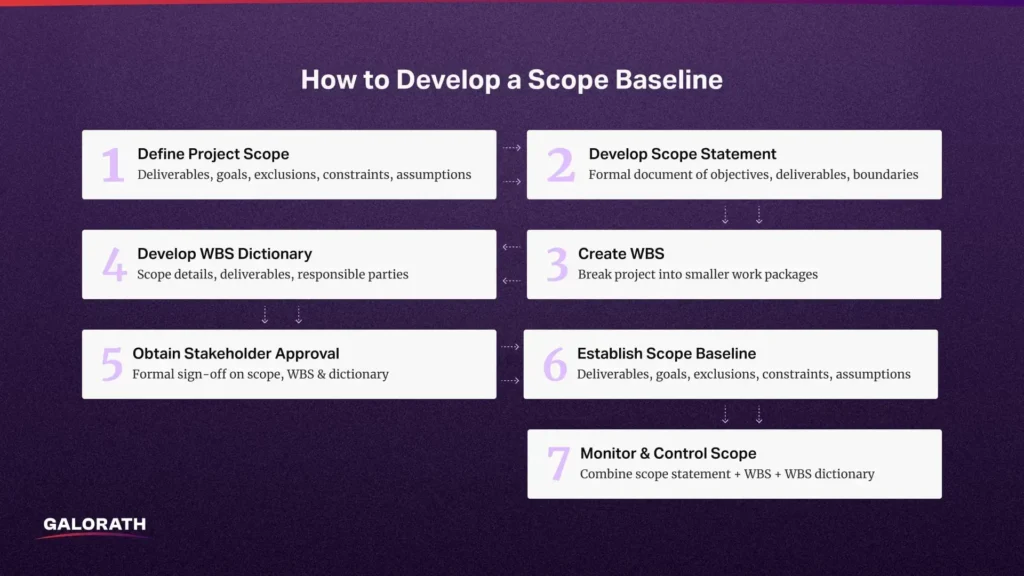
Creating a scope baseline is a detailed process that ensures the project’s scope is clearly defined, documented, and approved. This step-by-step guide will walk you through the process of developing an effective scope baseline.
The first step in developing a scope baseline is defining the project’s scope. This involves clearly outlining the work that needs to be done to achieve the project’s objectives. Key elements to consider include:
This step ensures that everyone involved in the project has a shared understanding of what the project entails and what it does not.
The project scope statement is the formal document that clearly defines the project’s deliverables, objectives, exclusions, and any constraints. The scope statement should provide a comprehensive description of:
The project scope statement forms the foundation of the scope baseline and should be reviewed and approved by stakeholders before moving forward.
The Work Breakdown Structure (WBS) breaks down the project scope into smaller, more manageable components. These components are known as work packages, which represent tasks or groups of tasks that can be assigned, scheduled, and tracked.
To create the WBS, follow these steps:
The WBS helps organize the work into clear components, which makes it easier to estimate resources, schedule tasks, and monitor project progress.
The WBS dictionary provides detailed descriptions of each work package listed in the WBS. It includes important information such as:
The WBS dictionary ensures that everyone involved understands the scope and specific requirements for each work package and serves as a reference throughout the project.
Once the project scope statement, WBS, and WBS dictionary are developed, it’s critical to obtain formal approval from all key stakeholders. This ensures that:
The scope baseline requires formal stakeholder approval, as it is essential to create alignment and commitment to the project scope. Without formal approval, there is a risk of scope changes or confusion later in the project.
After obtaining stakeholder approval, combine the three elements—project scope statement, WBS, and WBS dictionary—into the official scope baseline. This baseline is the agreed-upon version of the scope and serves as the benchmark for:
The scope baseline is a critical reference point throughout the project, providing a clear definition of what the project is intended to achieve.
Once the scope baseline is established, the next step is to continuously monitor and control the project scope. This involves comparing actual project performance against the scope baseline to identify any deviations. If changes are necessary, follow the formal change control process:
Ongoing monitoring and control ensure that the project stays aligned with its objectives, and any scope changes are properly managed and documented. In the graph bellow, we can graphically see all 7 steps to develop a scope baseline:
The scope baseline is a critical tool in project management across various industries, as it helps define, track, and control the scope of projects to ensure they stay within defined boundaries. Here are some of the most popular industries where the scope baseline plays an important role:
In construction projects, the scope baseline is essential for defining the physical deliverables, timelines, and budget. It ensures that the project stays within the agreed-upon parameters, such as the size, structure, and materials used. The scope baseline helps manage changes in design, materials, and regulations, providing a clear framework for controlling project scope and avoiding costly overruns.
Example: Building a commercial skyscraper requires detailed planning and scope definition. The scope baseline helps ensure deliverables are completed correctly—from foundation to roofing—are completed according to specifications and timelines.
In IT and software development, the scope baseline ensures that software projects meet their defined objectives and adhere to their established timelines. It is used to track the development of features, functionalities, and integrations as per the original project scope. Managing scope is crucial to preventing scope creep, a common issue in software projects where new features or requirements are added without considering the time and budget constraints.
Example: A software development project, like creating a mobile app, involves setting clear requirements. The scope baseline defines the features and functionalities that need to be developed, ensuring alignment with stakeholder expectations.
In the pharmaceutical and healthcare industries, the scope baseline is used to manage regulatory requirements, research objectives, clinical trials, and product development. The scope baseline helps ensure that projects are compliant with strict regulations and timelines, minimizing risks related to health, safety, and regulatory approvals.
Example: Developing a new drug involves clinical trials, regulatory compliance, and safety checks. The scope baseline will ensure that these tasks are completed within the agreed-upon scope, with no unauthorized changes to the process.
Aerospace and defense projects are highly complex and require precise scope management due to the critical nature of their deliverables. The scope baseline is crucial in defining the technical specifications, safety requirements, and regulatory compliance needed to meet industry standards. It also helps in controlling costs, timelines, and performance metrics.
Example: Building a fighter jet or spacecraft requires precise definitions of every component, from avionics to propulsion systems. The scope baseline tracks all work packages to ensure that the project meets military specifications.
Projects in the energy and utilities sector, such as building power plants, installing electrical grids, or implementing renewable energy solutions, require a robust scope baseline to ensure that technical and safety requirements are met. The scope baseline helps define the infrastructure needs, project timelines, environmental impacts, and regulatory compliance.
Example: A renewable energy project like installing wind turbines must adhere to specific engineering and environmental standards. The scope baseline defines the deliverables and schedules, ensuring all necessary work is completed on time and within scope.
In manufacturing and product development, the scope baseline helps ensure that all design specifications, quality control processes, and timelines are adhered to. It helps manage changes in design, materials, and production methods, ensuring that the project stays on course and within budget.
Example: A project to develop a new consumer electronics product, like a smartphone, requires a detailed scope baseline to track design specifications, production schedules, and resource allocation.
In event planning, the scope baseline defines the objectives and deliverables for the event, such as venue selection, guest lists, schedules, and activities. It ensures that the event meets the expectations of stakeholders, whether for a corporate conference or a large-scale public event.
Example: Planning an international conference involves organizing various components like venue, catering, guest speakers, and accommodations. The scope baseline ensures that each deliverable is completed on time and within the agreed scope.
In each of these industries, the scope baseline serves as a foundational document that ensures that all stakeholders are aligned, risks are managed, and the project is completed successfully within its defined constraints. By providing a clear structure and a point of reference, the scope baseline is essential for avoiding scope creep, managing changes, and delivering projects on time and within budget.
In Agile and hybrid projects, the concept of scope baselining differs from traditional project management approaches, but it still plays a vital role in ensuring the project stays focused on its objectives. Here’s how scope baselining maps to backlog and release scope in these frameworks:
In Agile projects, scope baselining typically happens at the release level rather than at the start of the project. The project scope is defined incrementally through the product backlog, which is a dynamic list of features, user stories, and tasks that need to be completed.
Backlog as the Baseline: The product backlog serves as a fluid reference point for scope management. At the start of each sprint or iteration, a subset of the backlog (known as the sprint backlog) is selected and baselined as the scope for that sprint. This creates a temporary baseline that is fixed for the sprint, but it can evolve with each iteration as new features are added, or requirements change.
Release Scope: For larger releases, the backlog is grouped into releases that represent a set of features to be delivered. The release scope serves as a high-level baseline, but it remains flexible and can change based on stakeholder feedback, performance, or market conditions. Thus, while the scope baseline in Agile is somewhat fluid, it still sets expectations for deliverables in each iteration or release.
The scope baseline in Agile ensures that teams have a clear direction for each sprint or release while remaining adaptable to new inputs and changes.
In hybrid projects—which combine elements of both traditional and Agile methodologies—the scope baseline is a hybrid approach that involves setting a baseline for both the high-level project scope and the more flexible, iterative elements of Agile. Here’s how it works:
High-Level Scope Baseline (Traditional): At the start of the project, the overall project scope is defined using traditional methods. This includes the project scope statement, WBS, and WBS dictionary, which create a high-level baseline of deliverables, timeline, and resources.
Agile Backlog Baseline (Agile): As the project progresses, particularly in the development or execution phases, Agile methods kick in. The backlog is continually updated, and specific sprints are scoped based on the evolving needs and stakeholder feedback. The scope baseline for each release can shift, but it still ensures that the project delivers against its key objectives.
Integrated Change Control: In hybrid projects, it’s important to manage changes both at the high level (project scope) and at the release or sprint level (backlog). While the high-level scope baseline remains relatively fixed, the backlog scope baseline is more flexible, allowing for changes as the project progresses, especially during regular feedback loops.
In both Agile and Hybrid approaches, the scope baseline remains a vital tool for setting expectations, guiding development, and ensuring that projects are aligned with their goals, even though the scope is more adaptable than in traditional methods.
Let’s take a look at an example of a scope baseline for a website development project to understand how the components come together in a real-world scenario.
Project Overview: The goal is to develop a company website that includes key features such as a homepage, product pages, a contact form, and a blog section.
The project scope statement for this website development project might include the following details:
Objectives: Create a fully functional company website that is mobile-responsive, user-friendly, and optimized for search engines (SEO).
Deliverables
Exclusions
Constraints
Acceptance Criteria
The WBS breaks down the project scope into smaller tasks, such as:
1.0 Website Development
2.0 Quality Assurance
3.0 Project Management
The WBS helps break down each deliverable into manageable tasks and assigns responsibilities to different team members.
The WBS Dictionary (Breakdown Structure Dictionary) provides further details for each of the work packages in the WBS, such as keyword definitions, resource requirements, schedule details, and performance criteria.
1.1 Homepage Design
1.2 Product Pages Development
Yes, a scope baseline can change after approval, but it requires a formal process. Any changes to the scope must go through a change control process where the impact is assessed, and relevant stakeholders approve the changes before the baseline is updated.
The difference between the two is that the scope statement is a document that defines the project’s objectives, deliverables, exclusions, and constraints, while scope baseline is the approved version of the scope statement, work breakdown structure (WBS), and WBS dictionary. Scope statement serves as the foundation for understanding what the project will deliver, while scope baseline serves as the reference point for managing and controlling scope throughout the project and provides the formal baseline for comparison and measurement.
The difference between the two is that the scope of work (SOW) is a detailed description of the tasks, deliverables, and objectives required for the project, typically used in contracts and agreements, while scope baseline is the formalized, approved version of the project scope that includes the scope statement, WBS, and WBS dictionary. Scope baseline acts as the official reference for measuring progress and managing scope throughout the project.