AI Cost Estimation
 AI Project Scheduling
 AI Risk Assessment & Mitigation
 AI Labor Estimation
 Work Breakdown Structure
 Design for Manufacturing (DFM)
 Should Cost Analysis
 Price to Win (PtW)
 Total Cost of Ownership
 Design to Cost
 RFI, RFP, RFQ


Mastering Cost Risk with the CRED Model: A New Approach to Managing Uncertainty


New: SEERai by Galorath
With SEERai, teams move from raw data to estimates in hours instead of weeks. Every output is traceable, audit-ready, and designed to improve decisions across estimating, sourcing, and risk.
Introducing SEER by Galorath
SEER Overview →Galorath’s platform combines trusted cost logic with AI to deliver fast, structured estimates that drive better decisions from design through delivery.
AI use cases
See AI Use Cases →Essential use cases
See All Use Cases →Latest articles

Why Most ROI Models Miss the Real Value of Estimation

Table of Contents
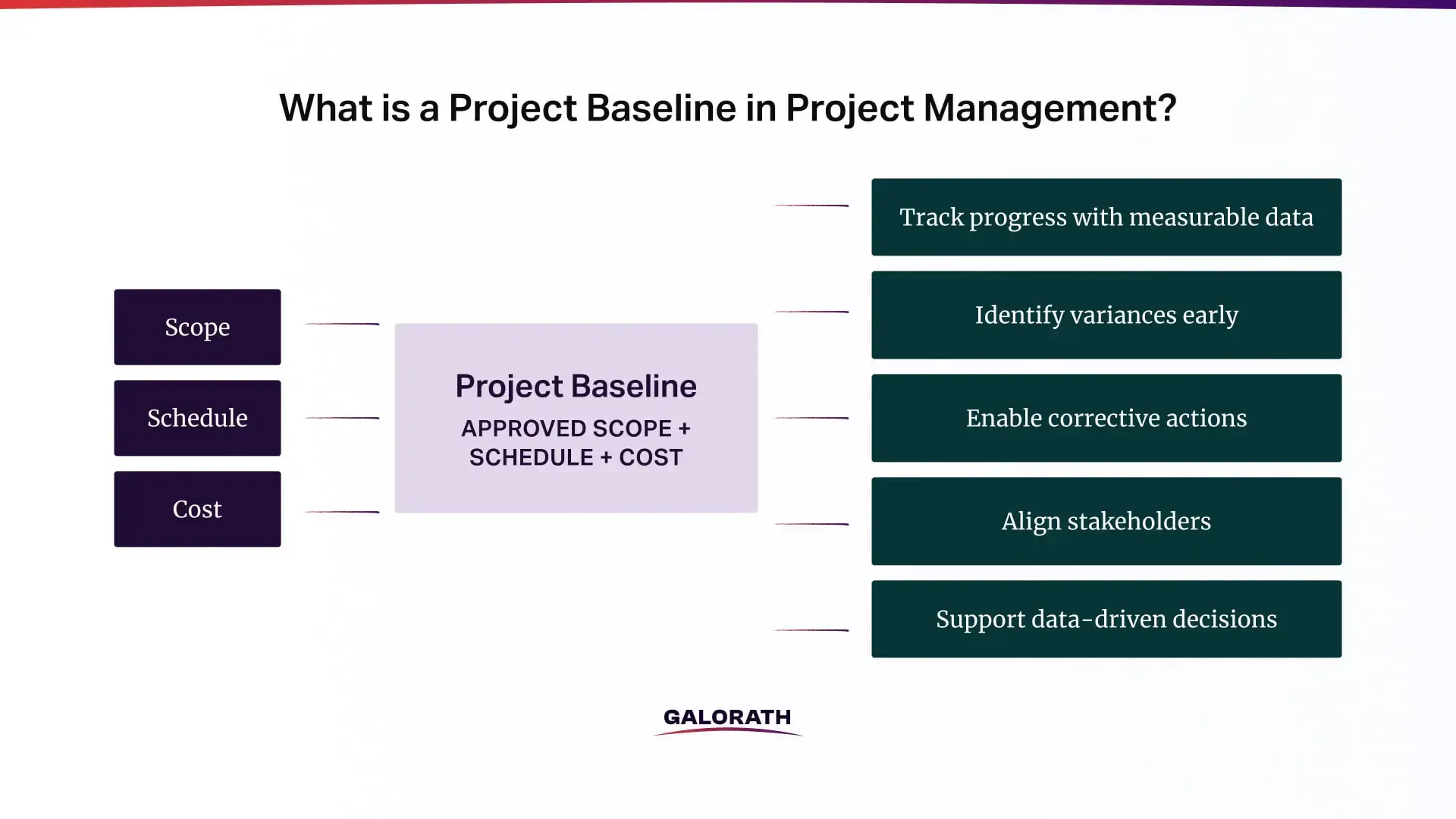
A project baseline is the fixed, initial plan for a project’s scope, cost, and schedule, serving as a benchmark to track progress and measure performance against original objectives throughout the project lifecycle. It serves as a fixed reference point to measure and control project performance. Project baselines are set at the end of the planning phase. They represent the original plan agreed upon by stakeholders.
Once established, project baselines are used to track progress, compare actual results, and identify variances. Project managers use baselines to spot issues early, assess risks, and take corrective actions. Without a project baseline, performance tracking lacks structure and teams lose clarity on whether the project is on track or off course. Baselines are also used to support earned value management and help ensure accountability.
The project manager is responsible for setting the project baseline, but it requires collaboration with team members, stakeholders, sponsors, and the PMO. Project baseline becomes official only after formal review and approval.
Four main types of project baselines exist and those include scope baseline, schedule baseline, cost baseline, and quality baseline. These baselines provide the framework for tracking performance and maintaining control across all key areas. Together, baselines help prevent scope creep, manage timelines and budgets, and ensure deliverables meet agreed quality standards.
A well-defined project baseline provides a clear benchmark for evaluating change requests, ensuring that any rebaselining is handled through a structured, approved process. Baselining a project means more than simply recording initial plans—it is the formal approval of scope, schedule, and cost into a single performance measurement baseline. By keeping the baseline current and accurate, project managers strengthen accountability, improve forecasting, and build trust with stakeholders.
In the Waterfall framework, the project baseline is fixed upfront and scope, schedule, and cost are locked in and used as strict benchmarks for tracking performance and controlling changes. In Agile framework, baselines are more flexible and iterative, with release plans, sprint goals, and velocity serving as short-term reference points that adapt as the project evolves.
Reliable project baselines are created by project managers by using structured methods like Work breakdown structure, scheduling, and cost estimation with popular tools such as Microsoft Project, Primavera P6, Smartsheet, Jira and Procore. Usage of these methods and tools enables accurate planning, integrated control of scope, schedule, and cost, and formal change management when rebaselining is required.
A project baseline is the approved version of a project’s scope, schedule, and cost plans, used to monitor and evaluate project performance throughout its lifecycle.
According to the PMBOK® Guide (7th Edition) by the Project Management Institute (PMI), the baseline is part of the performance measurement baseline (PMB)-a key element in integrating scope, time, and cost to track progress against the plan. It is used to detect deviations, manage change, and support performance evaluation using techniques like Earned Value Management (EVM).
PMI defines project baseline as the approved version of a work product that can be changed only through formal change control procedures and is used as a basis for comparison.
In project management, the baseline is the foundation for controlling the project. Project baseline enables teams to:
In the following graph, we can see what is project baseline made out of, and for what it is used for.
Without a baseline, it’s impossible to determine if the project is on track, over budget, or behind schedule. Baselines also provide the foundation for project forecasting and performance reporting, ensuring accountability and transparency across teams and stakeholders. A project baseline is more than just a planning document-it is the foundation for managing, monitoring, and controlling a project. Here are the key reasons why it is essential:
The baseline acts as the reference point for tracking actual performance against planned values. By comparing real-time progress to the baseline, project managers can assess whether the project is ahead, behind, or on schedule and budget. This provides clarity on how well the project is executing against its original plan.
When variances occur, project leaders need accurate data to make decisions. The baseline offers objective insight into what was planned versus what is happening. This helps managers take corrective actions based on evidence, not assumptions, reducing the risk of reactive or misguided choices.
Baselines allow early detection of scope creep, cost overruns, or schedule delays. For example, if tasks are taking longer than planned or costs are escalating, comparing them to the baseline makes it immediately visible. Early identification means problems can be addressed before they threaten project success.
Earned Value Management requires a solid baseline to measure planned value (PV), earned value (EV), and actual cost (AC). Without a baseline, EVM cannot be applied, and you lose the ability to analyze performance trends, cost efficiency, and schedule effectiveness.
A baseline gives all stakeholders a shared understanding of the original plan. Status reports, forecasts, and updates can be framed against the baseline, making communication more consistent and transparent. It also provides justification for any necessary changes.
As the project progresses, teams can use deviations from the baseline to revise estimates and forecasts. For example, if certain tasks took longer than expected, future tasks can be re-estimated using actual performance data, improving overall planning accuracy.
All change requests are evaluated against the project baseline. This makes it easier to understand the full impact of a proposed change on scope, time, and cost. It also ensures that changes are not approved arbitrarily but through a formal change management process.
The baseline defines the agreed-upon targets for all key metrics. By setting expectations early, it becomes easier to hold team members accountable for delivery. It also clarifies who is responsible for what, based on the baseline’s original plan.
With a clear and documented baseline, the entire team has visibility into what success looks like. It prevents misunderstandings, ensures alignment, and fosters a culture of openness about how the project is progressing.
After the project ends, the baseline remains a valuable record for evaluating project outcomes. It helps identify lessons learned by comparing what was planned to what was delivered, and informs planning for future projects with real-world performance data.
A project baseline is created at the end of the planning phase, before project execution begins. In the project lifecycle, the planning phase involves defining the project scope, developing the schedule, and estimating costs. Once these elements are finalized, approved, and integrated, they form the baseline-a formal, fixed reference for tracking performance.
As Alan McDougald explains in his “The integrated project baseline“ book, “project baselines are determined at or immediately following the time of project authorization,” and this includes scope, budget, and schedule as agreed during planning. The baseline is not created during initiation or execution; it is established only after planning is complete and before work starts.
According to the PMBOK® Guide, baselines become part of the Project Management Plan once all planning components have been reviewed and signed off through the integrated change control process. At this point, the baseline is considered “locked,” and any changes afterward must go through formal change management procedures.
The project manager is the primary role responsible for creating and setting the project baseline.
According to the PMBOK® Guide, the project manager leads the integration of scope, schedule, and cost planning into a single, cohesive baseline. While the project manager prepares the baseline with input from team members, functional managers, and stakeholders, they are ultimately accountable for ensuring the baseline is accurate, approved, and formally documented.
However, setting the baseline is not a solo effort, since it requires:
The baseline becomes official only after being reviewed and approved through the integrated change control process. This approval is typically given by:
Baselining a project means finalizing and formally approving the project’s scope, schedule, and cost plans to create a fixed reference point for measuring performance.
As Dr. Amandeep Singh Marwaha explains, “a baseline provides a starting point from which a comparison can be made… [and] represents the standard that is used to measure the performance of the project.” Once the planning phase is complete, the project manager compiles all the approved plans into a unified baseline. This process includes:
These three components together form the performance measurement baseline (PMB), which is used to track actual progress and identify variances.
The main difference between project baseline and project plan is that project plan is a comprehensive document that outlines how the project will be executed, monitored, and controlled, while project baseline is a subset of the project plan, which consists of the approved scope, schedule, and cost. Project plan includes multiple components such as the scope management plan, schedule management plan, risk plan, communication plan, and more, while project baseline is used specifically to measure project performance.
Here is a table representation of different aspects of project plan and project baseline:
| Aspect | Project Plan | Project Baseline |
| Purpose | Guides overall project execution and control | Tracks performance against approved targets |
| Components | Includes all management plans and baselines | Scope, schedule, and cost baselines only |
| Flexibility | Continuously updated as needed | Fixed unless formally changed |
| Use Case | Operational guidance | Performance measurement and variance analysis |
In project management, baselines are essential for tracking and controlling performance. While the performance measurement baseline (PMB) typically focuses on scope, schedule, and cost, there are four distinct types of baselines that support comprehensive project control: scope, schedule, cost, and quality. Each serves a unique purpose and is created during the planning phase, then monitored and managed throughout the project lifecycle.
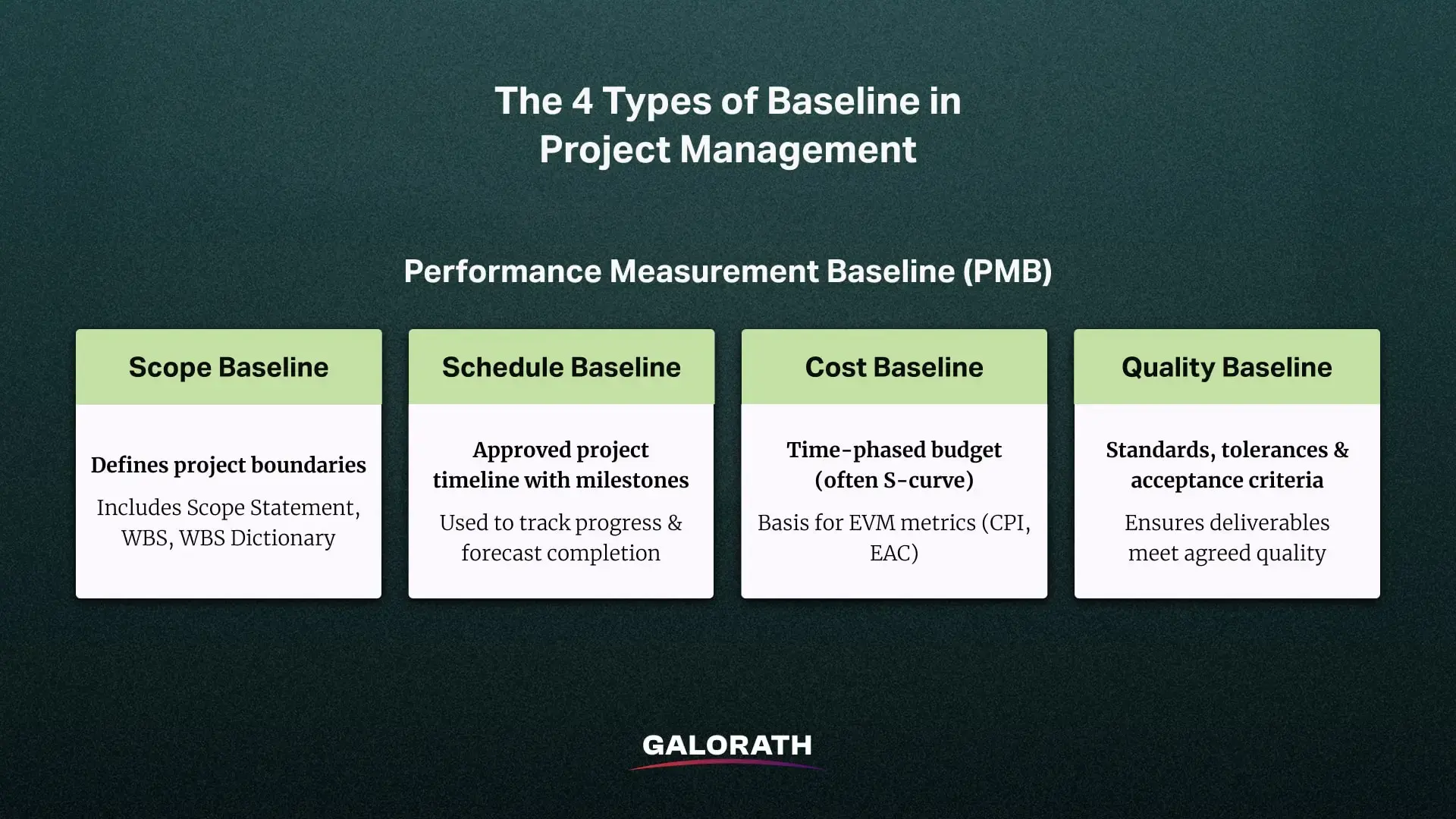
The scope baseline defines the boundaries of the project-what is included and what is excluded. It ensures that the team delivers exactly what was agreed upon with stakeholders.
It is composed of:
The scope baseline helps prevent scope creep, supports change control, and serves as a reference when evaluating change requests.
The schedule baseline is the approved version of the project timeline. It includes:
It acts as the reference point for measuring actual progress. If activities are delayed or accelerated, the variance is assessed against the schedule baseline. It’s also essential for forecasting completion dates and evaluating project health.
The cost baseline is the approved time-phased budget. It shows:
This baseline is used to track actual costs and identify budget overruns. Cost baseline is also the foundation for calculating earned value metrics like Cost Performance Index (CPI) and Estimate at Completion (EAC).
The quality baseline outlines the accepted quality standards and performance criteria for the project and its deliverables. It includes:
It ensures all deliverables meet the agreed level of quality and helps guide the Quality Management Plan. This baseline is especially critical in regulated industries or high-risk projects.
To understand how a project baseline works in practice, consider a simple example: launching a company website.
In this example, the baseline defines exactly what will be built, how long it will take, how much it will cost, and the quality standards that must be met. These baseline values are used throughout the project to monitor progress and control changes.
Without a project baseline, managing and controlling a project becomes reactive, inconsistent, and prone to failure. A baseline provides a reference point; without it, teams lack direction, and decisions are made without objective data. Below are the key problems that arise when a project has no baseline:
Without a fixed plan to compare against, there’s no way to track progress. Project managers can’t tell if the project is on schedule, within budget, or meeting scope expectations, leading to guesswork instead of data-driven decisions.
The absence of a baseline removes the boundaries for scope, schedule, and budget. This results in uncontrolled scope creep, frequent delays, and unexpected cost overruns, because there’s nothing to enforce or measure against.
When a change request arises, there’s no benchmark to assess its impact. This makes it difficult to determine whether the change affects the project significantly, leading to unstructured, undocumented modifications and confusion among stakeholders.
Team members cannot be held responsible for deliverables or timelines if no original expectations are defined. This leads to misaligned efforts, finger-pointing, and reduced team performance.
Without a baseline, reporting becomes unclear and inconsistent. Stakeholders don’t know what to expect or how current progress compares to the original plan, eroding trust and confidence in the project.
Without historical baselines, future projections become unreliable. Teams cannot estimate time or cost-to-completion accurately, increasing the risk of failure in long-term projects.
A baseline brings visibility to what was planned. Without it, stakeholders, clients, and leadership cannot clearly see how the project is progressing or where it stands at any given point.
Not having a project baseline results in poor control, miscommunication, lack of accountability, and increased risk. It undermines every aspect of project execution and makes successful delivery difficult to achieve.
Yes, a project baseline can be changed-but only under formal, controlled conditions. Once established, the project baseline is meant to remain fixed to allow accurate performance tracking. However, in real-world projects, circumstances can change significantly. When those changes affect the original scope, schedule, or cost in a material way, updating the baseline becomes necessary.
This process is not informal or ad hoc. According to the PMBOK® Guide, any adjustment to the baseline must be approved through the Integrated Change Control process, ensuring that only necessary and justified changes are implemented.
You need to rebaseline a project when the original scope, schedule, or cost plan is no longer realistic or valid due to significant changes or disruptions. As Teakon J. Williams explains, “multiple change requests or variation orders… often lead to cost overruns, schedule overruns, and scope creeps,” and failure to manage these changes systematically can jeopardize project success.
Rebaselining means replacing the current baseline with a new, approved version that reflects updated plans, expectations, and commitments. This process is not automatic-it must go through formal change management procedures, and the new baseline must be approved by the project sponsor or the Change Control Board (CCB). According to Frank P Saladis and Harold Kerzner in the “The Change Control Process” project changes are needed when it is deemed necessary to change the scope, time or cost of one or more previously approved project deliverables, and such changes must go through a formal review and approval process to maintain control over project performance.
When there is a substantial increase or reduction in project scope, the original baseline becomes invalid. New deliverables may require additional tasks, time, and budget, which must be reflected in a new baseline.
Example: A client adds two new features to a software project, extending development by three weeks and increasing cost.
If critical tasks fall behind and catch-up is not feasible without affecting project quality or cost, the baseline schedule must be updated to reflect new delivery timelines.
Example: A delayed permit in a construction project pushes the entire timeline by a month. The schedule baseline is redefined with new milestones.
If costs have exceeded planned values and remaining work cannot be completed within the original budget-even with corrective actions-a revised cost baseline is needed.
Example: Material prices spike by 40% after planning, and cost mitigation efforts fail to keep the project within budget.
If the project is paused for an extended time and later resumed, original estimates, resource availability, and timelines are likely outdated. Rebaselining aligns the plan with current realities.
Example: A public-sector IT project is frozen due to budget cuts, then resumed a year later under new leadership and modified scope.
New compliance requirements or environmental conditions may force scope adjustments, activity changes, or new budget allocations-making the old baseline obsolete.
Example: A pharmaceutical project must integrate new FDA compliance steps after a mid-project regulation update.
If significant errors are discovered in the original baseline-such as incorrect estimates, missed dependencies, or flawed assumptions-a corrected and reapproved baseline is necessary.
Example: Duration estimates were based on outdated task data, causing consistent slippage across work packages.
When project direction changes due to new contracts, mergers, or stakeholder shifts, the original plan may no longer reflect the new business objectives.
Example: A project is realigned from a local to a global rollout strategy, requiring new timelines, budgets, and scope definitions.
Rebaselining is necessary when the original project baseline becomes invalid due to major scope, cost, or schedule changes. The project manager must initiate the change request and go through the formal change control process to gain approval. Once approved, the updated baseline becomes the new standard for measuring project performance.
Project baselines are used differently in Agile and Waterfall frameworks due to their contrasting approaches to planning, change, and execution.
In the Waterfall model, project baselines are formal, fixed, and established before execution begins. Waterfall projects follow a linear and sequential process, which emphasizes upfront planning. The scope, schedule, and cost baselines are locked in during the planning phase and used as strict benchmarks to measure progress and control deviations.
Example: In a construction project using Waterfall, the baseline is set after detailed architectural plans, timeline, and cost estimates are approved. Any deviation, such as material cost increases or design changes, requires formal change approval.
In Agile, the concept of a baseline is more flexible and iterative. Agile projects emphasize adaptability and incremental delivery, which means scope and requirements evolve over time. Instead of one fixed baseline for the entire project, Agile teams use release plans, sprint goals, and velocity metrics as working baselines.
Example: In a software development project using Scrum, the team commits to delivering a set of features in a 2-week sprint. The sprint plan acts as a temporary baseline, which is evaluated and reset in the next sprint based on feedback and progress.
| Feature | Waterfall | Agile |
| Planning Style | Predictive and fixed | Adaptive and iterative |
| Scope Baseline | Fixed upfront | Evolving, defined sprint by sprint |
| Schedule Baseline | Approved start and end dates | Time-boxed iterations (e.g., 2-week sprints) |
| Cost Baseline | Fixed budget planned in advance | Often fixed cost per sprint/team |
| Change Management | Formal, through change control | Built-in flexibility; backlog reprioritization |
| Performance Tracking | Against full project baseline | Against sprint goals and velocity metrics |
In Waterfall, the project baseline is a rigid control tool established once. In Agile, baselining is adaptive, focusing on incremental targets like sprint commitments and release plans. Both approaches use baselines to measure performance, but the level of flexibility and formality differs significantly.
Developing a reliable project baseline requires accurate data, structured planning, and the right tools and techniques to align scope, schedule, and cost. Below are the most effective tools and methods used by project managers to establish solid, traceable baselines:
The WBS is essential for defining the scope baseline. It breaks the project down into manageable components, ensuring that all deliverables are clearly defined before estimating time and cost.
Tool examples:
To develop the schedule baseline, you need tools that allow you to map out tasks, durations, dependencies, and milestones. These tools help visualize the critical path and adjust timelines based on real-time inputs.
Tool examples:
Accurate cost estimation is key to setting the cost baseline. These tools support budget planning, resource cost loading, and financial forecasting.
Tool examples:
These platforms help align scope, schedule, and cost in one place, allowing for real-time updates and baseline locking. They also support performance tracking, change control, and reporting.
Tool examples:
Beyond tools, reliable methods must be used to ensure baseline accuracy:
Once the baseline is created, it must be protected. These systems manage proposed changes, track approvals, and ensure any baseline modifications are formally documented.
Tool examples:
The project baseline is essential for accurate performance tracking because it provides the planned values against which actual project data is measured. Without a baseline, there’s no objective way to determine whether the project is on track, ahead, or falling behind. As Luis Mayo-Alvarez states, “technical success is associated with achieving the expectations of the project baseline,” and effective baseline performance management enables project managers to track deliverables, timelines, and costs accurately.
One of the most effective methods for using the baseline in performance tracking is through Earned Value Management (EVM).
Earned Value Management relies directly on the project’s scope, schedule, and cost baselines to calculate key performance indicators. These metrics help project managers assess both the current state and future projections of the project.
Here’s how EVM uses the baseline:
From these, you can calculate:
All of these calculations depend on having a fixed, approved baseline.