

 Add Galorath as a preferred source on Google
Bottom-up estimation is a detailed method used in project management to predict costs, duration, and resources. It works by breaking a project down into smaller tasks and estimating each one individually. This method contrasts with top-down or analogous approaches, which rely on broader assumptions or historical comparisons. When project scope is clearly defined, bottom-up estimating produces some of the most accurate forecasts available, though it requires significant time and resource investment to execute properly.
Its role within project management extends beyond initial budgeting. Bottom-up estimating provides traceability at the task level, helping project teams align scope with cost and schedule requirements. By isolating tasks, the method allows for early identification of risks, more informed resource planning, and stronger stakeholder confidence. These advantages are particularly useful in complex or high-stakes projects, where oversight and precision are critical to successful delivery.
The process involves several structured steps: defining scope, creating a task hierarchy, estimating resources, calculating costs and duration, and aggregating the data into a project-level forecast. This is followed by validation, adjustment for risk, and continued monitoring throughout the project lifecycle. When executed correctly, the method ensures that each element of the project is accounted for and that the estimates remain responsive to evolving conditions.
Software tools enhance this approach by supporting data structure, revision tracking, and cross-functional collaboration. Estimation platforms allow for granular input and real-time recalculations as assumptions change. In advanced applications, bottom-up forecasting may be validated or refined using parametric models, which provide benchmark comparisons based on historical project data. Together, these practices reinforce the reliability of estimates and support adaptive project planning across various domains.
What Is Bottom-Up Estimating?
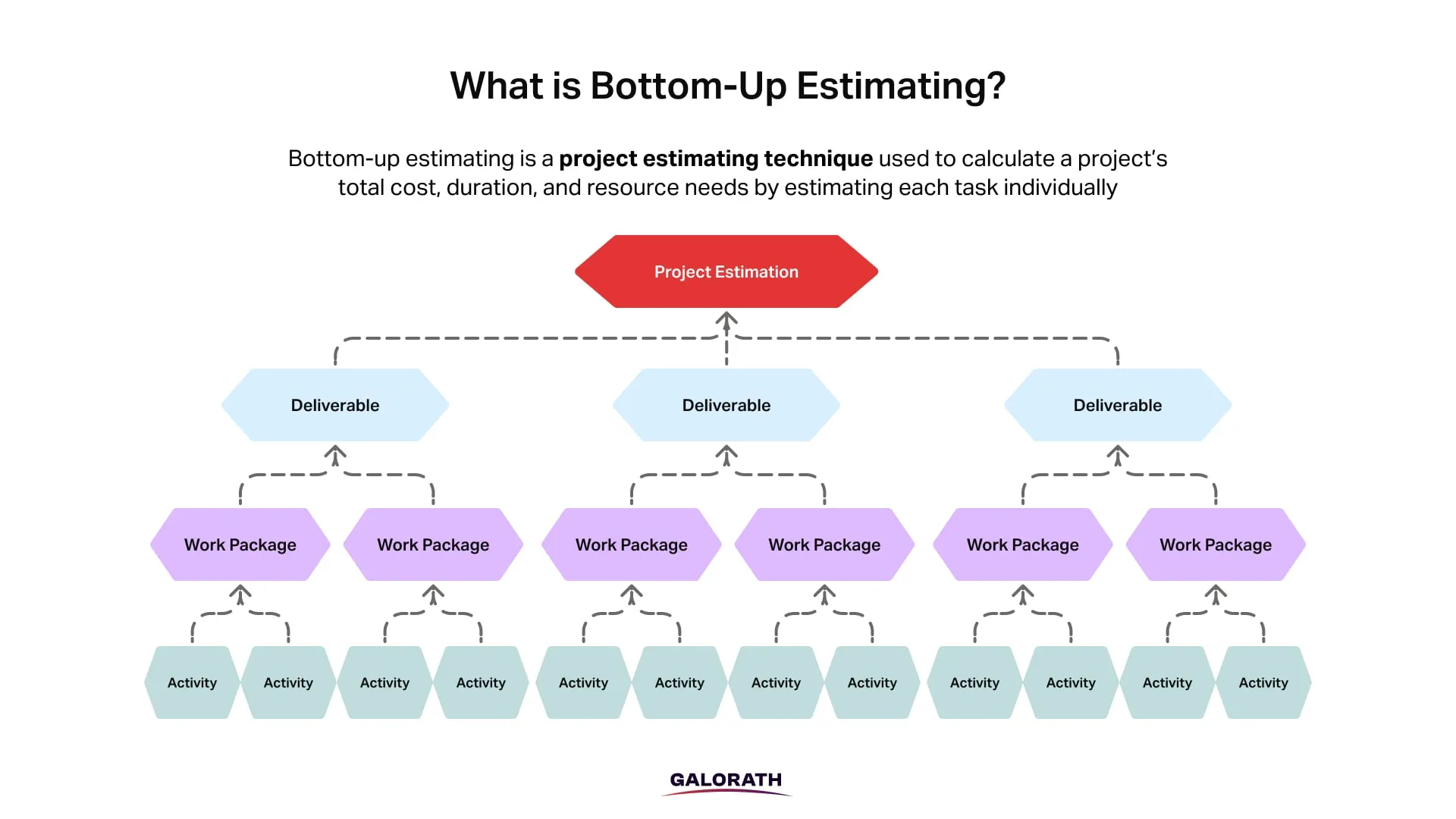
Bottom-up estimating is a project estimating technique used to calculate a project’s total cost, duration, and resource needs by estimating each task individually, at it’s lowest level. It’s also called “deterministic estimation” or “detailed estimation” because it focuses on specific tasks or work packages. Unlike other methods, bottom-up estimating starts with the smallest details and adds them up to form the overall estimate.
The term “bottom-up” comes from this approach: estimates are built from the ground up, starting with individual tasks and then combining them. This is different from top-down estimating, where a general estimate is made first and refined later.
In a project management textbook, Philip Bauer explains that “bottom-up estimating is more detailed and effort-intensive but results in the most accurate projection when scope clarity exists”.
A key feature of bottom-up estimating is its granular approach, providing highly accurate estimates when detailed information is available. However, it’s resource-intensive and requires more time upfront to gather all the necessary data, making it the most time-consuming estimation method. A study done by Chan-Geun Park and Hyung-Woo Seo found that “while bottom-up estimation takes more time, it reduces cost overruns due to its precise forecasting ability”.
The Role of Bottom-Up Estimating in Project Management
Bottom-up estimating is key to defining a project’s cost and schedule by breaking down each task’s effort, cost, and duration. Each task’s estimate directly impacts the overall project cost and timeline, ensuring more accurate projections.
This method is closely linked to the project scope and project budgeting. By estimating each task in detail it helps ensure that all parts of the project are covered, reducing the chances of missed tasks or unexpected costs. This leads to a more reliable budget. “This methodology ensures full traceability of costs at every task level,” as highlighted in an engineering cost analysis paper written by Shi Tang and Kazuya Shide.
Bottom-up estimating also helps manage risk. By looking at each task individually, project managers can spot potential issues early, whether it’s time, resources, or costs. This allows for better planning and reduces the risk of surprises during the project. According to a study done by Katherine Lonergan, “task-level estimation identifies high-risk components before implementation begins”.
How Bottom-Up Estimating Works?
Bottom-up estimating involves breaking a project into smaller tasks or work packages and in order to do so, these are the steps which should be followed:
1. Creation of Work Breakdown Structure (WBS)
The first step is to break the project down into smaller, manageable tasks or work packages, which is done by creating a work breakdown structure. This helps define the project scope and organize all the necessary components.
2. Estimate Each Task
Once the tasks are identified, each one is estimated individually. This includes calculating the time, cost, and resources needed to complete each task. The more detailed the input, the more accurate the estimate will be. According to the Ocean Engineering article, “bottom-up estimating requires subject matter experts to evaluate inputs, yielding a bottom line that reflects real effort”.
3. Combine Estimates
After estimating each task, the individual estimates are combined to form the overall project estimate. This includes adding up the total cost and duration for all tasks.
4. Review and Adjust
The overall estimate is reviewed to ensure it fits within the project scope and budget. If necessary, adjustments are made to certain tasks to balance the overall estimate.
5. Monitor and Update
As the project progresses, the estimates can be updated if new information arises or if changes are made to the project scope. This helps keep the project on track and allows for adjustments in case of any unforeseen circumstances. One relevant case study supports this theory by stating, “iterative refinement is integral to bottom-up strategies, especially in scope-evolving projects”.
When to Use Bottom-Up Estimating?
Bottom-up estimating is typically used during the detailed project planning phase, following the creation of the Rough Order of Magnitude (ROM) estimate. The ROM serves as an early, high-level estimate, providing a rough idea of potential costs and durations based on limited information. This initial estimate helps guide the project’s early decisions and serves as a starting point for more refined planning.
As the project scope becomes clearer, bottom-up estimating is introduced to provide more precise and reliable estimates. At this stage, the project is broken down into smaller tasks or work packages. Each of these components is estimated in detail for cost, duration, and resources. A study done by Priya Varshini about software effort estimation states that “bottom-up estimation becomes practical only after high-level scoping yields component breakdowns”.
Therefore, bottom-up estimating is applied after the initial ROM estimates and once the project scope has been clearly defined. It plays a crucial role in refining the estimates, ensuring that the project is accurately budgeted and scheduled.
Comparing Bottom-Up Estimating with Other Techniques
There are several techniques used for project estimation, each with its strengths and weaknesses. In this section, we’ll compare bottom-up estimating with other popular techniques: top-down estimating, analogous estimating, and parametric estimating. A table below summarizes the key differences, helping you understand when and why each method is used.
A project management guide by Phillip Bauer explains, “bottom-up estimating demands more effort but offers granular visibility unmatched by other techniques”. And according to Jens Newig, “Top-down and bottom-up approaches work best together in project management.”. A table below summarizes the key differences, helping you understand when and why each method is used.
| Estimating Technique | Bottom-Up Estimating | Top-Down Estimating | Analogous Estimating | Parametric Estimating |
| Approach | Breaks the project into smaller tasks and estimates each one individually. | Provides a high-level estimate for the whole project and refines it later. | Uses historical data from similar projects to estimate. | Uses mathematical models to estimate cost or duration. |
| Accuracy | Highly accurate when detailed data is available. | Less accurate, as it’s based on broader assumptions. | Fairly accurate, depending on data from similar projects. | Accuracy depends on the quality of historical data and models. |
| Time and Effort | Time-consuming, requires significant effort upfront. | Faster, as it’s based on general assumptions. | Relatively quick, based on available historical data. | Quick, once the model is set up. |
| Best for | Large, complex projects requiring precise estimates. | Smaller projects or early stages of a project. | Projects with similar past examples. | Projects with sufficient historical data and clear patterns. |
How to Perform Bottom-Up Estimating (Step-by-Step)
Bottom-up estimating is a detailed process that involves breaking down a project into its smallest components and estimating the cost, time, and resources required for each. Here’s a comprehensive, step-by-step guide on how to perform bottom-up estimating:
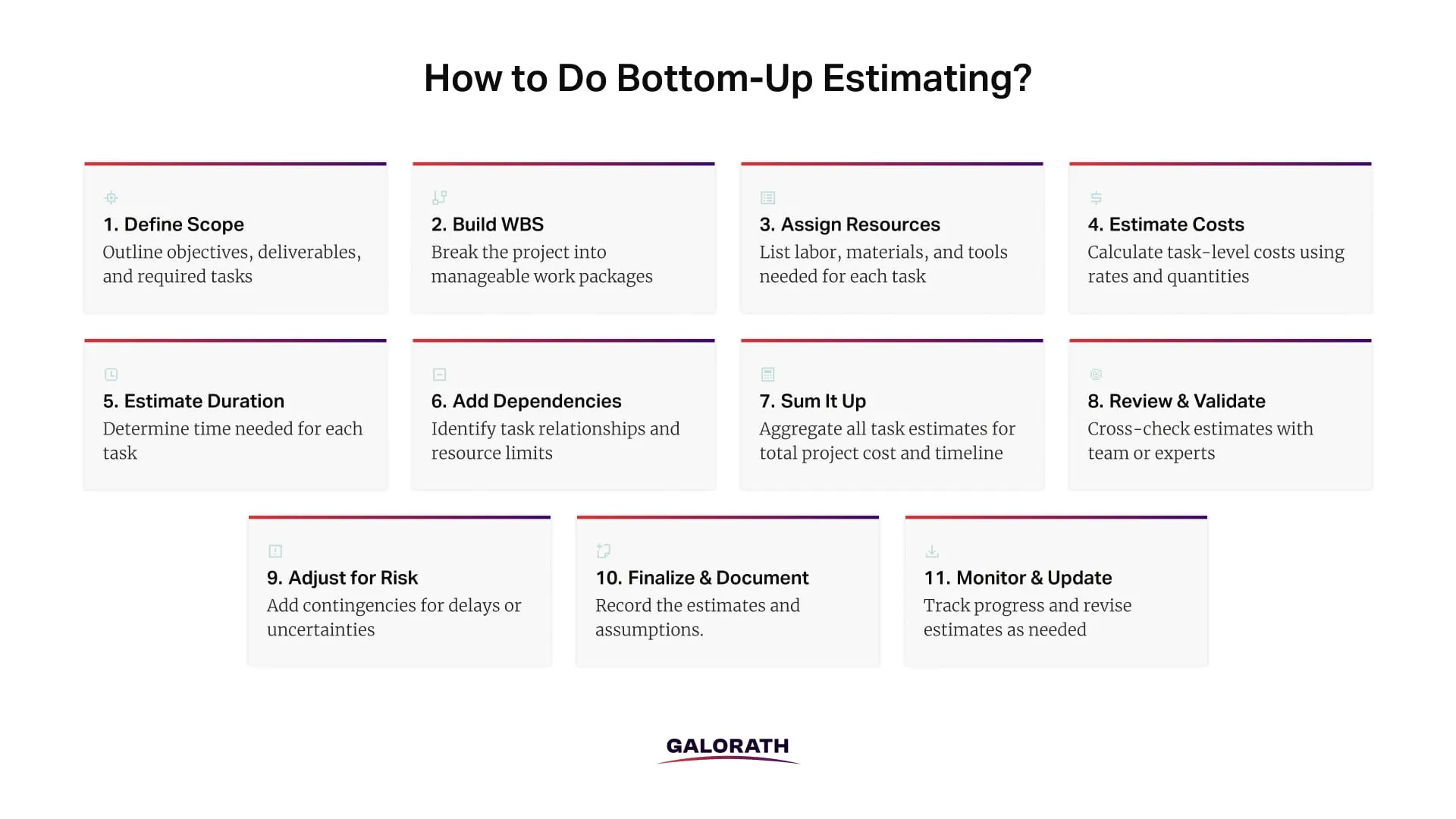
Step 1: Define the Project Scope
The first step in bottom-up estimating is to define the project scope clearly. This involves outlining the overall objectives, deliverables, and specific tasks or work packages that need to be completed. A detailed scope statement helps identify exactly what needs to be estimated and ensures the project’s requirements are fully understood.
Step 2: Create a Work Breakdown Structure (WBS)
Once the project scope is defined, the next step is to break the project into smaller, manageable tasks or work packages. This is where you create the Work Breakdown Structure (WBS), which is a hierarchical decomposition of the project’s tasks. Each work package should be defined clearly enough to provide accurate estimates for costs, duration, and resources.
Step 3: Identify the Resources for Each Task
Next, identify the resources required for each individual task or work package. This includes labor, equipment, materials, and any other resources that will be needed to complete the task. Be specific about the quantity and quality of each resource to ensure accurate cost and duration estimates.
Step 4: Estimate the Cost for Each Task
Now, you need to estimate the cost for each task. This can involve calculating the cost of labor, materials, equipment, and other resources based on historical data or expert judgment. Use detailed rates and quantities to create precise task-level estimates. You may also use specialized software or templates to help track and calculate these costs more efficiently.
Step 5: Estimate the Duration for Each Task
Next, estimate the duration for each task. This involves determining how long each task will take to complete, considering the available resources. Duration estimation can involve expert judgment, historical data, or mathematical models to predict how long each task will take under typical conditions.
Step 6: Add Dependencies and Constraints
In this step, identify any dependencies and constraints between tasks. Some tasks can’t start until others are completed, or certain resources might be limited. Understanding these relationships is crucial for creating an accurate overall timeline. Document these task dependencies to ensure the project flows smoothly.
Step 7: Aggregate the Estimates
Once all individual tasks are estimated, aggregate the estimates for costs, durations, and resources to form the total project estimate. This step involves summing up the estimates from each task to create an overall project cost and schedule.
Step 8: Review and Validate the Estimates
After aggregating the estimates, review them for accuracy and consistency. Cross-check with the project team or experts to validate assumptions, refine estimates, and ensure all tasks are accounted for. This step also involves comparing the estimates to any available historical data to ensure they align with realistic expectations.
Step 9: Adjust for Risks and Uncertainties
At this point, it’s important to consider any risks or uncertainties that might affect the project. Adjust your estimates for any known risks, such as delays or resource shortages. Adding contingency allowances can help account for unexpected events that could impact the project’s cost and duration.
Step 10: Finalize and Document the Estimates
Once all adjustments are made, finalize the bottom-up estimates and document them clearly. This should include detailed descriptions of how the estimates were derived, along with any assumptions or conditions. These estimates will serve as the baseline for managing the project as it progresses.
Step 11: Monitor and Update Estimates Throughout the Project
Finally, bottom-up estimating is not a one-time process. As the project progresses, continuously monitor and update the estimates. This involves tracking actual progress and comparing it to the initial estimates, adjusting as necessary for changes in scope, resources, or other factors.
Here is a visual representation of 11 steps on how to do proper bottom-up estimating:
6 Advantages of Bottom-Up Estimating
1. High Accuracy
Bottom-up estimating offers high accuracy because it is based on a detailed analysis of each task or work package. Since each component is individually estimated, the final project estimate is more reliable. As Professor Dvulit notes, “The bottom-up method provides a more granular and accurate approach to project estimation, especially when detailed task-level data is available.”
2. Thorough Resource Planning
By estimating at the task level, this method helps ensure that resources are properly allocated for every part of the project. It provides a clear view of what resources are needed, reducing the chance of shortages or resource conflicts. Bottom-up estimation ensures that resources are planned at the task level, minimizing the risk of resource allocation issues.
3. Clear Project Scope
Breaking down the project into smaller tasks ensures that every part of the project scope is accounted for. This leads to a more comprehensive understanding of the project’s requirements and a lower likelihood of scope creep. According to Simion-Melinte, “A clear project scope is an essential result of bottom-up estimation, as it helps define the deliverables precisely.”.
4. Better Risk Management
Bottom-up estimating helps identify potential risks early, as each task is examined in detail. This proactive approach allows project managers to plan for uncertainties and mitigate risks effectively. Runge explains that, “By breaking down tasks, risks can be identified early on, allowing for early mitigation strategies.”.
5. Improved Stakeholder Confidence
Detailed estimates often increase the confidence of stakeholders, as they can see that the project has been carefully planned with realistic projections for costs and timelines. As Michael Chapko suggests, “Stakeholders trust bottom-up estimates because they are based on thorough task-level analysis and are less likely to be arbitrary.”.
6. Facilitates Accurate Scheduling
With precise task durations and resource requirements, bottom-up estimating helps in creating a more accurate project schedule. This improves the likelihood that the project will be completed on time. Magne Jørgensen states, “The accuracy of task-level estimates directly impacts the precision of the project timeline.”.
7 Disadvantages of Bottom-Up Estimating
1. Time-Consuming
One of the main drawbacks of bottom-up estimating is that it requires significant time and effort. Breaking down every task, gathering detailed input, and calculating estimates for each component can be very labor-intensive. As Douglas Gransberg points out, “The detailed nature of bottom-up estimating often leads to longer preparation times, which may delay project initiation.”.
2. Resource-Intensive
Because bottom-up estimating involves input from various team members and experts for each task, it requires more resources than higher-level estimation methods like top-down estimating. This can strain team members and delay the planning phase. Resource allocation for the estimation process itself can be overwhelming for large teams.
3. Potential for Over-Estimation
Due to its highly detailed nature, there’s a risk of overestimating certain tasks, especially if overly cautious assumptions are made about task durations or resources. This can lead to inflated project costs. Overestimation is a risk when the estimation process is excessively cautious, leading to unnecessarily high budgets.
4. Requires Detailed Information
For bottom-up estimating to be effective, detailed information about the project scope, tasks, and resources is necessary. If this information is unavailable or incomplete, the accuracy of the estimates may suffer. Accurate estimates depend on the availability of detailed and reliable task-level data.”
5. Limited Flexibility in Early Phases
In the early phases of a project, when details are still unclear, bottom-up estimating may not be as useful. Rough Order of Magnitude (ROM) estimates are typically preferred before detailed task breakdowns can be made. As Michael Chapko suggests, “In early project phases, ROM estimates offer a more flexible and quicker approach.”.
6. Increased Complexity for Large Projects
As projects grow in size and complexity, bottom-up estimating can become overwhelming. Managing and calculating estimates for a large number of tasks can lead to mistakes, miscalculations, or oversights, particularly without specialized software. Larger projects amplify the risk of estimation errors due to the sheer volume of tasks and data.
7. Possibility of Scope Creep
Since bottom-up estimating involves estimating every task, it can sometimes uncover tasks or components that were not initially considered. This can lead to scope creep, where new tasks and requirements are added after the estimation phase. As Cezar Simion-Melinte warns, “The task breakdown often reveals additional requirements, leading to scope creep if not carefully managed.”.
Common Mistakes to Avoid in Bottom-Up Estimating
When performing bottom-up estimating, several common mistakes can undermine the accuracy and reliability of your estimates. One major error is underestimating task complexity. It’s easy to overlook the intricacies of certain tasks, leading to overly optimistic time and cost predictions. Another mistake is failing to involve the right subject matter experts.
Not consulting the team members who will actually perform the work can result in inaccurate estimates and missed requirements. Similarly, overlooking dependencies between tasks can lead to unrealistic schedules, as some tasks may require others to be completed first.
Additionally, not factoring in project risks or uncertainties is a critical oversight. Risk events, such as unexpected delays or resource shortages, should be built into the estimates to avoid significant cost overruns.
Over-aggregating estimates is another mistake—combining estimates too early or inaccurately can lead to inflated totals, especially if individual task estimates aren’t reviewed thoroughly. Lastly, failing to regularly update estimates as the project progresses can cause estimates to become outdated, creating discrepancies between the planned and actual project costs and timelines.
Expert Tips for More Accurate Bottom-Up Estimates
To achieve the most accurate bottom-up estimates, project managers can employ various strategies that enhance the precision of the process. Below are expert tips for improving the reliability of task-level estimates:
Involving Subject Matter Experts
One of the most effective ways to improve the accuracy of bottom-up estimates is to involve subject matter experts (SMEs). These experts have firsthand experience with specific tasks or work packages and can provide valuable insights that may not be immediately obvious. By collaborating with team members who have practical knowledge of the project’s requirements, project managers can ensure that each task is accurately estimated. SMEs can also help identify potential risks or challenges that might not be visible at the planning stage, leading to more realistic estimates.
Using Historical Data
Another key strategy is to leverage historical data from similar past projects. Historical data provides a solid foundation for creating reliable estimates, as it reflects real-world costs, durations, and resource allocations. By analyzing data from previous projects that are similar in scope, size, or industry, you can identify patterns and trends that help refine your estimates. For instance, if certain tasks took longer or required more resources in previous projects, you can adjust your current estimates accordingly. This data-driven approach increases the accuracy of bottom-up estimating and reduces the reliance on assumptions.
Re-Evaluation and Adjustment Techniques
Re-evaluating and adjusting estimates throughout the project is another critical practice for maintaining accurate projections. As the project progresses and new information becomes available, revisiting your initial estimates ensures they stay aligned with the project’s evolving scope and needs. Regular reassessment allows project managers to identify discrepancies between the planned and actual progress, enabling them to adjust timelines, budgets, and resource allocations as necessary. Additionally, using contingency planning helps account for potential risks or delays, ensuring that the project remains on track even when unexpected issues arise.
Tools and Software Supporting Bottom-Up Estimation
Software systems that support bottom-up estimating serve primarily to structure large volumes of project data into discrete, manageable components. This structure typically mirrors a work breakdown framework, allowing users to define individual tasks or deliverables and associate specific values to each in terms of cost, duration, and resource demand. By converting informal assumptions into standardized input fields, such tools reduce the variability that often arises in manual estimation. The software also enforces consistency in how task dependencies, labor assignments, and overhead calculations are applied, which is particularly useful in collaborative or multi-phase projects. This structural consistency aids not only in the calculation of aggregate values but also in the reliability of the estimate as a whole.
Beyond structural organization, software extends the application of bottom-up estimating by embedding financial and logistical metrics directly into task-level data. Many systems integrate cost accounts, rate sheets, material pricing, and schedule logic, enabling users to estimate with precision and traceability. This practice is consistent with recommendations found in formal project management standards, where detailed, resource-loaded schedules are linked to cost management plans (PMI 2021). When estimation occurs at this level of granularity, it allows for a more accurate representation of constraints and resource availability, while also providing an audit trail of assumptions and source data. This becomes particularly valuable when multiple contributors are involved, as the tools allow subject matter experts to input estimates for their specific work areas while maintaining coherence across the broader plan.
These systems also offer mechanisms for revising estimates as project details evolve. Version tracking, change logs, and scenario modeling enable estimates to remain functional across planning phases, design iterations, or contractual changes. In practice, this allows teams to begin with partial data and refine estimates incrementally as more information becomes available. The capacity to maintain a living estimate without sacrificing traceability is one of the most significant advantages these tools offer over static spreadsheets or manual methods. In this way, software not only facilitates the initial application of bottom-up estimating but sustains its use across the entire project lifecycle, from early planning to post-execution review.
How SEER Supports Task-Level Estimation and Bottom-Up Forecasting?
SEER® is an AI-powered estimation platform which accommodates the logic of bottom-up forecasting by allowing users to define individual components, modules, or work packages and associate each with detailed inputs. These components can represent technical subsystems, software features, production units, or any other discrete elements depending on the project’s domain. Each unit is modeled independently using parameters such as complexity, team capability, development environment, and integration risk. Unlike static spreadsheets, SEER translates these variables into cost, schedule, and risk outputs through embedded parametric models. This structure supports the logic of bottom-up estimation while adding a layer of predictive consistency, especially useful when components differ in scale or technical difficulty.
The system’s architecture supports the hierarchical aggregation of estimates from subcomponents to entire systems. When inputs at the task or module level are modified—such as labor allocation, hardware reuse, or defect rates-SEER recalculates the higher-level forecast without requiring manual recomputation. This is consistent with bottom-up estimating principles, where the total project forecast is derived from individual work units. In SEER, however, the interaction between variables is preserved across levels. This allows for more accurate reflection of cumulative effects, such as schedule compression penalties or compounding technical debt. It also provides a clearer audit trail when justifying the estimate to stakeholders or responding to changing requirements.
SEER also supports iterative use of bottom-up estimation through its scenario modeling and data calibration features. Users can compare alternative configurations of component-level estimates and retain historical versions as reference points. Estimates can be revised incrementally as better data emerges, without sacrificing internal consistency. This flexibility is particularly valuable in long-duration or high-uncertainty environments, where assumptions must be updated as engineering decisions evolve. By supporting decomposition, aggregation, traceability, and revision, SEER enables bottom-up estimation to function not as a one-time planning task but as an adaptive forecasting process embedded within the broader lifecycle of the project.
The Role of Parametric Estimating in Validating Bottom-Up Projections
Parametric estimating plays a crucial role in validating bottom-up projections by providing a data-driven, statistical approach that complements the detailed, task-level estimates generated through bottom-up estimating. While bottom-up estimating focuses on breaking down each project task into granular components, parametric estimating uses historical data and mathematical models to predict project costs, durations, and resource requirements based on predefined parameters.
The integration of both methods helps ensure that the bottom-up estimates are not only accurate but also consistent with industry standards and historical trends.
By applying parametric estimating to validate the overall project estimate, project managers can assess whether the bottom-up projections align with expected cost per unit, time per task, or other relevant metrics derived from past projects. This validation process provides an additional layer of confidence, especially for large projects where the bottom-up approach may be prone to overestimating or underestimating certain tasks.
Challenges of Integrating Parametric with Bottom-Up Estimating
While the combination of parametric estimating and bottom-up estimating offers significant advantages, it also presents a few challenges that need to be addressed for effective integration. One common issue is calibration, which involves aligning the two methods’ assumptions and inputs to ensure they work together smoothly. For example, if the parametric model uses different assumptions about resource availability or cost structures than the bottom-up estimates, discrepancies can arise, leading to conflicting projections.
Another challenge is overfitting. This occurs when the parametric model is too closely tailored to past project data, which may not be fully applicable to the current project. As a result, it may produce estimates that are too rigid or narrowly defined, neglecting the unique elements of the project. Overfitting can lead to skewed comparisons with bottom-up estimates, potentially distorting the accuracy of the combined projection.
Additionally, conflicting outputs can arise when the two estimating techniques yield significantly different results. If bottom-up estimating produces a higher cost or longer duration estimate compared to the parametric model, project managers must carefully evaluate the root causes of these discrepancies.
Frequently Asked Questions About Bottom-Up Estimating
How accurate is bottom-up project estimation?
Bottom-up estimating is highly accurate when detailed data is available. It is more reliable than top-down estimating, but requires more time and effort.
Is Bottom-Up Estimation Responsive to Project Scope Changes?
Yes, bottom-up estimation can be updated as the project scope changes, making it adaptable to evolving project needs.
Can Bottom-Up Estimating be used in Agile projects?
Yes, bottom-up estimating can be used in Agile projects to estimate individual tasks or user stories, though it needs to be adapted for iterative cycles.