

 Add Galorath as a preferred source on Google
Cost estimation has become a sophisticated discipline that aggregates all cost elements using validated data to forecast future expenditures. In modern complex projects, reliable cost estimation underpins successful budgeting, strategic planning, and clear procurement processes. Whether used for early-phase project feasibility or full-lifecycle forecasting, it plays a pivotal role in shaping project success and financial viability.
In this comprehensive guide about cost estimating, you’ll discover:
- What a cost estimate truly represents and how it differs from a budget
- How cost estimation fits within the project lifecycle and key decision points
- A taxonomy of cost estimate types and their appropriate applications
- A comparison of estimation methods – from bottom-up to AI-enabled parametric models
- Classification frameworks and when to use each class of estimate
- Why accurate cost estimation matters and who is responsible for it
- What are the 5 types of project costs
- What is Operating & Support (OS) cost estimating
- Key performance metrics, including Cost Variance and Estimate at Completion
- Essential software tools such as SEER and BIM-integrated platforms
- Industry-specific case studies in IT, software, and manufacturing
- Best practices aligned with the GAO’s 12-step methodology
Looking for a Cost Estimating Software?
SEER by Galorath delivers fast, defensible estimates powered by advanced parametric models.
Reduce uncertainty, forecast with confidence, and avoid costly overruns!
What Is Cost Estimation?
Cost estimation is the process of forecasting the financial resources needed to complete a project, product, or task. The GAO defines a cost estimate as “the summation of individual cost elements, using established methods and valid data, to predict the future costs of a program, based on what is known today.”
This emphasis on structured, repeatable estimation is also supported by both the AACE and PMI, which advocate the use of historical data, expert judgment, and formalized models to ensure cost estimate reliability.
A cost estimate is the quantified result of this process. It provides a phased projection of expected costs, refined progressively as the project scope evolves. Estimates serve multiple functions: they support budget development, guide financial planning, inform procurement, and help stakeholders make data-driven decisions. They are essential across sectors, from aerospace and construction to manufacturing and software development.
To be considered reliable, a cost estimate must meet four key criteria outlined by the GAO: comprehensive, well-documented, accurate, and credible.
What’s the difference between Project Cost Estimate and Project Cost Budget?
The main difference between the two is that the project cost estimate forecasts what a project is expected to cost, while a project cost budget, on the other hand, is the authorized amount of funding allocated to execute the project. Estimates are inputs to budgeting, but budgets also reflect organizational constraints, funding strategies, and risk contingencies.
Relying on a rough estimate to set a fixed budget (or vice versa) can lead to misaligned expectations, cost overruns, and compliance issues during audits. Aligning the estimate and budget at the appropriate project phase ensures financial control and stakeholder confidence.
Cost Estimation in Project Management
Cost estimation is a core discipline within project cost management – one of the ten knowledge areas outlined in the PMBOK Guide by the Project Management Institute (PMI). It provides the analytical foundation for setting realistic financial expectations, allocating resources, and making scope and procurement decisions with confidence.
In PMI’s framework, estimation takes place during the “Estimate Costs” process and directly informs the “Determine Budget” and “Control Costs” phases. Together, these processes ensure that financial projections transition into executable plans and that actual expenditures are monitored and corrected in real time.
Estimation accuracy is a pivotal driver of project performance. Poor estimates cascade into unreliable budgets, unrealistic schedules, and unmet stakeholder expectations. Industry data shows that 32% of project cost overruns are attributed to flawed estimates, highlighting the need for rigorous and standardized practices.
Cost engineering plays this crucial role. Beyond being a technical task, it combines forecasting, performance measurement, and risk modeling into an integrated process. Certified professionals, typically credentialed through AACE or ICEAA, use proven techniques such as parametric modeling, Monte Carlo simulation, and lifecycle cost analysis to improve precision and create traceable, defensible cost models.
Projects that incorporate these structured methods, especially probabilistic or parametric techniques, are more likely to surface risks early. This allows for preemptive adjustments to scope, resources, or schedules before costs spiral out of control.
In short, effective cost estimation bridges the gap between conceptual intent and financial execution. It transforms assumptions into actionable figures and ensures that business objectives are delivered with fiscal accountability and stakeholder trust.
Why Accurate Cost Estimation Matters?
Accurate cost estimation is a foundational element of project success because it ensures that budgets reflect reality, resources are allocated appropriately, and strategic decisions are grounded in credible financial data. As a core project success factor, precise estimating directly influences whether a project stays on time, within scope, and under budget.
Yet across industries, inaccurate cost estimation remains a systemic challenge. Inaccurate cost estimations often lead to cascading consequences: missed deadlines, scope reductions, rework, and loss of stakeholder trust.
The impact extends beyond budget spreadsheets. Poor estimates erode stakeholder confidence, disrupt funding pipelines, and damage organizational reputation. When sponsors and executives lose faith in estimation reliability, future projects face tighter scrutiny, constrained funding, or outright rejection.
Conversely, high-accuracy estimates empower project teams to make informed decisions. They enable financial risk management through early identification of high-cost drivers and more effective contingency planning. This foresight improves both procurement strategies and schedule realism while supporting faster, more agile responses to cost pressures as they arise.
Organizations that consistently deliver accurate estimates achieve a tangible competitive advantage. They win bids based on credibility, avoid cost-related disputes, and make smarter capital allocation decisions across portfolios.
Accurate cost estimation is more than a budgeting exercise; it’s a pillar of financial integrity, strategic foresight, and project delivery excellence. Robust estimation practices are essential not just for budgeting but for building stakeholder trust, avoiding disputes, and ensuring long-term project and organizational success.
Who Is Responsible for Estimating the Project Cost?
Primary responsibility for estimating a project cost typically lies with a cost estimator or cost engineer, specialists trained to apply systematic methods like parametric modeling, analogous estimating, and risk-adjusted forecasting. These professionals use validated data and structured techniques to generate reliable financial predictions tailored to the project scope and lifecycle phase.
In complex or high-value initiatives, this function may be supported by a dedicated cost engineering team composed of analysts, systems modelers, and cost specialists. Their collective expertise ensures that estimates account for technical intricacies, historical benchmarks, and evolving risks.
The project manager (PM) plays a pivotal coordinating role. While not responsible for calculating estimates directly, the PM ensures that cost projections align with the project’s scope, schedule, and resource plans. The PM integrates cost estimation into the overall project baseline and facilitates validation by subject matter experts (SMEs), including procurement, engineering, and operations leads.
According to the GAO’s 12-step cost estimating process, expert judgment is required throughout. It informs the definition of ground rules and assumptions, guides data selection, and contributes to final estimate validation. Involving cross-functional stakeholders improves estimate credibility by incorporating diverse domain insights.
Cost estimation is a team effort: it demands accountability, transparency, and professional discipline. Estimates must be well-documented, reviewable, and defensible under internal governance or external audit standards.
Whether in government, aerospace, construction, or IT, stakeholder review and approval are essential steps in transforming cost estimates into actionable, trusted financial baselines.
How Cost Estimation Fits into the Project Management Lifecycle?
Cost estimation is an iterative, evolving process that spans all phases of the project management lifecycle. As a project matures, estimates shift from broad assumptions to precise, data-driven forecasts. This progressive estimate refinement ensures financial realism at every decision point and supports both traditional waterfall and Agile methodologies.
Initiation Phase: Early Forecasting with ROM (Class 5)
In the early stages, estimators produce a Rough Order of Magnitude (ROM) estimate, classified as Class 5. With only 0–2% of the scope defined, this high-level forecast is developed using top-down or analogous estimating techniques. It helps assess financial feasibility, screen alternatives, and justify initial business cases. Though highly uncertain, it frames early stakeholder discussions and investment decisions.
Planning Phase: Baseline Development with Class 4 and Class 3 Estimates
As the scope becomes clearer (10–40% defined), estimators apply parametric estimation techniques, hybrid approaches, or bottom-up project estimation to create Class 4 or Class 3 estimates. These methods support accurate budgeting, procurement planning, and resource allocation. This stage marks the shift from conceptual thinking to structured planning, where lifecycle cost estimation processes become more formalized.
Execution Phase: Real-Time Cost Tracking and Adjustment
During execution, the focus shifts to tracking actual costs against the approved cost baseline – the original agreed-upon budget and schedule. Earned Value Management (EVM) metrics, such as Cost Variance (CV), which shows the difference between earned value and actual cost, and Cost Performance Index (CPI), a ratio measuring cost efficiency, enable teams to detect deviations and optimize performance. Estimates are actively updated to reflect change orders (official project modifications), scope evolution (changes in objectives), and schedule adjustments.
Monitoring and Controlling Phase: Forecast Refinement
In this phase, estimators recalculate key forecasts like Estimate at Completion (EAC), which predicts the total project cost at completion, and Estimate to Complete (ETC), the expected cost needed to finish remaining work, using current performance data. This enables predictive cost control, helps reassess funding needs, and mitigates emerging risks. Techniques such as To-Complete Performance Index (TCPI), which measures the cost performance required to meet a target budget, are used to guide corrective action.
Closure Phase: Post-Mortem and Historical Archiving
At project closeout, teams compare actual costs to earlier estimates to assess estimation accuracy. The Basis of Estimate (BOE) is archived, and post-project reviews identify drivers of variance. This step strengthens organizational learning and improves future cost estimation methodologies.
Cost estimation is an iterative process, with increasing detail and accuracy as the project progresses through each phase. This lifecycle view reinforces the importance of refining estimates as scope and data become clearer, ensuring that financial projections remain realistic and actionable at every decision point.
Types and Classes of Cost Estimates
In professional cost estimation, it’s essential to distinguish between two core dimensions:
- Estimate Classes reflect the maturity and accuracy of the estimate. They are defined by the Association for the Advancement of Cost Engineering (AACE) and endorsed by the U.S. Government Accountability Office (GAO), based on the level of scope definition, available data, and methodology used.
- Estimate Types indicate the purpose of the estimate, such as feasibility screening, budget setting, or execution control, regardless of how developed it is.
While these terms are often used interchangeably, their distinction matters. Type explains why the estimate is being produced; class defines how developed and accurate it is.
Key Insight: One of the most frequent causes of budget overruns is using a high-level conceptual estimate (e.g., Class 5) to support final funding decisions. Always ensure the estimate’s type, class, and project stage are aligned.
Why This Types-Classes Alignment Matters?
In complex, multi-phase projects, whether in aerospace, infrastructure, or software development, cost estimates evolve through progressive elaboration. A feasibility estimate may begin as a rough Class 5, but as scope definition increases, it refines toward a Class 1 control estimate.
Properly aligning type (the estimate’s intent) with class (its maturity and accuracy) is essential to:
- Support realistic risk and scope planning
- Enable defensible financial decisions
- Build stakeholder trust and audit readiness
From a practitioner’s perspective, confusing these concepts often leads to flawed funding approvals, misused estimates, and exposure to cost overrun risks. Type addresses why you’re estimating; class defines how well developed that estimate is. Using the wrong combination at the wrong time undermines project credibility and financial control.
Key Insight: Never base a budget or contract on a Class 5 estimate. These are intended for early-stage screening, not execution or funding commitments.
5 Classes of Cost Estimates
Class 5 Estimate: Rough Order of Magnitude (ROM)
A Class 5 estimate, frequently named as Rough Order of Magnitude (ROM), is applied at the earliest stage of project conceptualization, typically when only 0–2% of the scope is defined. It offers a high-level feasibility forecast to support go/no-go decisions, with an expected accuracy range of -20% to -50% / +30% to +100%.
These estimates rely heavily on top-down techniques, such as analogous estimates from past projects and expert judgment, and are best suited for early-stage R&D or strategic investment screening.
When to use it: During ideation or business case validation, when only limited data is available. Class 5 estimates are often used during the conceptual phase of military acquisitions.
Limitations: High uncertainty; not appropriate for budgeting, procurement, or contractual commitments.
Class 4 Estimate: Intermediate Estimate
Class 4 estimates are used during initial concept development or business case analysis, when approximately 1–15% of the project scope is defined. Accuracy typically ranges from -15% to -30% / +20% to +50%.
These estimates are often produced using parametric or analogy-based techniques that rely on defined cost drivers.
When to use it: Feasibility studies, pre-design validation, or preliminary funding requests. Class 4 estimates are commonly applied in public infrastructure, utilities, pharmaceuticals, and large-scale IT programs to support early-stage feasibility and funding justification before detailed scope is defined.
Key strength: Useful for narrowing alternatives and excluding non-viable designs before deeper investment.
Class 3 Estimate: Preliminary Budget Estimate
Developed when 10–40% of the scope is defined, a Class 3 estimate serves as the basis for initial budget approval and procurement planning. Accuracy improves to -10% to -20% / +10% to +30%.
This estimate often uses a hybrid methodology, blending top-down parametric modeling with bottom-up detail for known elements.
When to use it: During planning phases to secure funding, align with stakeholders, or launch procurement activities. Class 3 estimates are standard in public infrastructure planning for preliminary budgeting.
Value-add: Enables budget realism while preserving flexibility for evolving design choices.
Class 2 Estimate: Definitive Estimate
A Class 2 estimate is used once 30–70% of the project scope is developed and technical requirements are defined. With an accuracy range of -5% to -15% / +5% to +20%, it supports procurement, contracting, and baseline definition.
Bottom-up techniques dominate at this stage, incorporating vendor quotes, detailed work breakdowns, and real-world data.
When to use it: Before tender issuance, contract negotiation, or freezing a final budget. Class 2 estimates are frequently used in industrial construction and aerospace programs just before contract award or procurement finalization.
Best practice: Include quantified risk-based contingencies to comply with GAO standards and increase credibility.
Class 1 Estimate: Detailed Control Estimate
Class 1 estimates are produced at 65–100% scope definition and represent the most detailed and accurate forecasts, with accuracy ranging from -3% to -10% / +3% to +15%.
These estimates use granular techniques such as fully itemized bases of estimate (BOEs) and integrate directly with Earned Value Management (EVM) and project accounting systems.
When to use it: During project execution to track costs, implement control actions, and report to governance bodies.
Strength: Enables real-time financial control, performance tracking, and compliance in high-stakes or mission-critical environments.
Dynamic Estimate Classification in Agile and Iterative Environments
In Agile, Lean, and other iterative project environments, cost estimates evolve continuously alongside the product backlog and development velocity. Rather than adhering to a fixed classification, estimates are reclassified dynamically based on updated scope, refined user stories, and empirical delivery data. This adaptive approach reflects the principle of progressive elaboration, enabling real-time alignment between financial forecasts and project realities.
What are most used Cost Estimation Methods and Techniques?
The most used cost estimation methods are Parametric, Analogous, Bottom-Up, Top-Down, Three-Point, and Expert Judgment. These range in accuracy from ±5% to ±50% depending on data quality and use case, from early-stage feasibility to procurement planning and risk-informed estimates.
What is Parametric Cost Estimating?
Parametric cost estimating is a method that uses mathematical models to estimate costs based on key cost drivers and historical relationships. Instead of manually calculating each individual component, this approach applies cost estimating relationships (CERs), such as cost per square foot, per labor hour, or per function point, to generate reliable, repeatable forecasts.
It is particularly useful in early project phases or when detailed task-level information is not yet available. By leveraging statistical correlations from past projects, teams can produce credible estimates quickly and consistently, even in complex or uncertain environments.
Key Characteristics of Parametric Estimating
Parametric cost estimating relies on historical data and statistical regression models to produce cost forecasts. It is highly scalable, making it suitable for estimating multiple project components or entire systems by applying cost estimating relationships (CERs). This method is especially effective in early-phase or conceptual estimates—such as Class 5 through Class 3—where detailed inputs may not yet be available. Many modern implementations of parametric estimating are enhanced with AI and Monte Carlo simulations, enabling sensitivity analysis and risk-adjusted outputs that improve confidence in cost predictions.
When to Use Parametric Cost Estimating?
Parametric estimation is ideal during early-stage feasibility assessments, especially when time and consistency are crucial. It excels in projects that include repetitive elements or where the primary cost drivers are already well understood. Because the method can be automated and standardized, it is frequently used to support strategic decision-making, comparative cost analysis, and bid development.
What are the limitations of parametric cost estimating?
Despite its strengths, parametric cost estimating has limitations, such as being less reliable for projects involving novel technologies or highly customized designs, where historical analogs may not apply. The method’s accuracy depends heavily on the quality and relevance of the historical data used. Additionally, estimates must be carefully calibrated to reflect current market conditions, cost escalations, and scope complexity to avoid misleading conclusions.
Analogous Cost Estimating
Analogous estimating, also known as top-down estimating, uses historical data from previous, similar projects to forecast the cost of a current one. It is quick and low-effort, making it useful during the early stages of project planning or when only limited scope information is available. However, it depends heavily on expert judgment and the assumption that past projects are sufficiently comparable, which may reduce accuracy if project conditions differ significantly.
Bottom-Up Cost Estimating
Bottom-up estimating builds a project’s total cost from the ground up by calculating the cost of each individual task or component and aggregating them. This method is the most detailed and accurate, particularly when a well-defined work breakdown structure (WBS) exists. It is ideal for definitive estimates, procurement, and budget approvals, but it can be time-consuming and requires substantial input data and team coordination.
Top-Down Cost Estimating
Top-down estimating begins with an overall cost target or budget and then allocates portions to individual components or phases based on proportional rules or expert input. While fast and helpful for strategic or executive-level planning, it lacks precision and may obscure underlying cost drivers, making it less appropriate for detailed planning or procurement stages.
Three-Point Cost Estimating
Three-point estimating models uncertainty by calculating three cost scenarios: optimistic, most likely, and pessimistic. These values are often combined using weighted averages or probability distributions to yield a more realistic forecast. Commonly used alongside Monte Carlo simulations, this method helps teams account for risk and variability, particularly in dynamic or high-uncertainty projects.
The table below summarizes six widely used estimation methods, outlining their data requirements, typical accuracy ranges, and best-fit use cases across industries:
| Method | Description | Data Requirements | Accuracy Range | Best Use Case |
| Parametric Estimating | Applies statistical models based on key cost drivers (e.g., $/sqft, $/LOC) | Medium to High | ±10–25% | Standardized, repeatable project elements |
| Analogous Estimating | Uses historical data from similar past projects to infer current costs | Low (similar project data) | ±30–50% | Early-stage feasibility with minimal data |
| Bottom-Up Estimation | Builds detailed estimates from individual tasks or components (WBS-level) | High (granular scope) | ±5–15% | Definitive estimates and procurement planning |
| Top-Down Estimation | Starts with total cost and allocates to components based on ratios or rules | Low | ±30–50% | Strategic planning and early-stage evaluations |
| Three-Point Estimating | Uses optimistic, most likely, and pessimistic values to model cost uncertainty | Medium | ±10–25% | Risk-informed estimates with significant variability |
| Expert Judgment | Relies on the experience of SMEs or estimators to assess likely costs | Variable | ±20–50% | Situations lacking data or precedent |
AI-Enhanced Estimation Techniques
Advanced analytics and AI have modernized traditional methods with enhanced data processing capabilities. Examples include:
- Machine Learning–Driven Parametric Estimation: Continuously refines cost predictions by analyzing historical performance and outcomes.
- Monte Carlo Simulations for Three-Point Estimating: Models probability distributions to generate confidence ranges for cost scenarios.
- Fuzzy Logic Systems: Accommodate vague or incomplete inputs, particularly useful in innovative or rapidly changing environments.
These approaches are especially valuable for agile development, systems engineering, or environments with high complexity and uncertainty.
Choosing the optimal estimation technique depends on the project’s maturity, complexity, and available data. Many organizations adopt hybrid strategies, combining parametric modeling with expert input or integrating three-point analysis into bottom-up frameworks. The increasing availability of AI-powered tools allows estimators to streamline workflows, improve accuracy, and enhance responsiveness in dynamic project contexts.
Will Cost vs. Should Cost: Strategic Cost Estimation Tools
Will Cost estimates reflect the actual expected costs based on current production and procurement conditions, while Should Cost estimates represent the ideal or target costs based on efficient manufacturing and best practices. Together, these estimates help organizations manage financial expectations, optimize spending, and improve supplier accountability.
What Is a Will Cost Estimate?
A Will Cost estimate represents the most realistic projection of expected expenditures based on current conditions, historical data, and established assumptions. It reflects what a project, product, or service is likely to cost given standard practices and known risk factors.
- Purpose: Establishes a defensible budget baseline for planning and funding approvals
- Methodology: Typically derived from historical actuals, vendor quotes, and standard contracting models
- Use Case: Life-cycle cost forecasting for capital investment, procurement budgeting, or program baselining
What Is a Should Cost Estimate?
A Should Cost estimate is a proactive analytical model used to determine what a project or deliverable ought to cost under optimal conditions. It focuses on eliminating inefficiencies and identifying potential cost savings through value engineering and benchmarking.
- Purpose: Drive cost reduction and improve negotiation leverage
- Methodology: Utilizes lean principles, market price analysis, and engineered cost models
- Use Case: Strategic sourcing, supplier negotiations, price challenge processes
How Will Cost and Should Cost Work Together?
- Will Cost provides financial realism by anchoring expectations in known variables and contract norms.
- Should Cost defines financial aspiration by highlighting where cost improvements may be achievable.
This dual-estimate framework supports smarter decision-making. For example, an agency may use Will Cost to secure funding, while deploying Should Cost to inform contract negotiation strategy and internal performance targets. In regulated or cost-sensitive industries, this approach enhances transparency, competitiveness, and cost control.
5 Types of Project Costs
Accurate cost estimation begins with a clear understanding of the different categories of project costs. These classifications shape how expenses are forecasted, tracked, and managed across the project lifecycle. Standards from GAO, AACE, and PMI consistently recognize five primary cost types, each with unique implications for budgeting, risk management, and financial control: direct costs, indirect costs, fixed costs, variable costs, and sunk costs.
These categories also support methodologies like Activity-Based Costing (ABC), lifecycle cost estimation, and Earned Value Management (EVM).
1. Direct Costs
Direct costs are those that can be attributed to a specific task, deliverable, or work package. These are the foundational components of most detailed estimates and are directly traceable through Work Breakdown Structures (WBS).
- Examples: Project-specific labor, purchased materials, subcontractor fees
- Estimation Role: Core elements in bottom-up and control estimates; tracked closely through project accounting systems
2. Indirect Costs
Indirect costs support overall project operations but cannot be easily tied to a single activity. They often include shared resources or general overhead and are typically allocated across multiple projects.
- Examples: IT support services, administrative salaries, office utilities
- Estimation Role: Allocated via cost drivers in ABC models or spread using burden rates
3. Fixed Costs
Fixed costs remain constant over a defined period, regardless of changes in project volume or pace. These costs are typically time-based and important for financial planning.
- Examples: Equipment rentals, office leases, long-term software licenses
- Estimation Role: Useful in early-phase budgeting and forecasting stable overhead contributions
4. Variable Costs
Variable costs fluctuate with the level of project activity. These costs are sensitive to scope and production changes, making them critical in agile or fast-scaling projects.
- Examples: Consumables, pay-per-use software, freelance hours
- Estimation Role: Inputs for sensitivity analysis, marginal cost modeling, and what-if scenarios
5. Sunk Costs
Sunk costs are expenses already incurred and irretrievable. Though not relevant for future estimates, they are essential for audits, post-project reviews, and avoiding escalation bias.
- Examples: Cancelled R&D efforts, initial feasibility studies, prototype development
- Estimation Role: Excluded from forward-looking decisions; analyzed in performance evaluations
Understanding and applying these cost categories strengthens estimation accuracy, enhances transparency, and supports informed financial decision-making throughout the project lifecycle.
What Is an Operating and Support Cost Estimate (OS Estimate)?
An Operating and Support (O&S) cost estimate projects the full range of expenditures required to operate, maintain, and sustain a system after deployment. Cost OS Estimating extends beyond acquisition and development costs, encompassing all post-implementation activities from fielding through system retirement.
According to the 2025 Operating and Support Cost Estimating Guide from the Defense Acquisition University (DAU):
“Operating & Support (O&S) consists of all effort related to sustainment; from initial system deployment/fielding through the end of system operations.”
O&S cost estimates include recurring and nonrecurring expenses such as maintenance labor, spare parts, consumables, technical data updates, training programs, software upgrades, and disposal. In defense, aerospace, and public infrastructure projects, these costs often represent over 70% of the total lifecycle expenditure.
Why O&S Cost Estimation Is Critical?
Neglecting to accurately estimate O&S costs can result in underfunded sustainment, degraded mission readiness, and unanticipated lifecycle overruns. For capital-intensive systems with long operational lifespans, understanding the Total Ownership Cost (TOC) is essential to budgeting, procurement, and trade-off analysis.
O&S estimates provide:
- Lifecycle financial visibility for long-term planning
- Cost baselines for sustainment budgeting and funding approvals
- Inputs to readiness and availability metrics
How O&S Costs Are Estimated?
The approach to estimating Operating and Support (O&S) costs depends on system maturity, data availability, and the operational profile. Common methods include:
- Historical analogies: Using data from predecessor or comparable systems
- Parametric models: Estimating costs based on metrics like cost per operating hour or maintenance event
- Activity-Based Costing (ABC): Aligning costs with usage intensity and mission profiles
- Expert judgment: Leveraging insights from logistics, reliability, and mission planning teams
These methods help create accurate and tailored O&S cost estimates throughout the system’s lifecycle.
Due to the long forecasting horizon and uncertain sustainment environments, O&S estimation is inherently complex. Best practices emphasize iterative updates, risk-adjusted modeling, and integration with Earned Value Management (EVM) and performance monitoring systems.
Robust O&S cost estimation strengthens program viability, informs lifecycle budgeting, and enables more accurate Total Cost of Ownership (TCO) projections.
Key Metrics and KPIs for Cost Estimation and Control
Effective cost estimation extends beyond forecasting; it requires ongoing control over financial performance. Metrics and KPIs, powered by Earned Value Management (EVM), provide critical real-time insight into cost health, enabling proactive decision-making and accountability.
| KPI | Formula | Insight | Typical Use |
| Cost Variance (CV) | CV = EV − AC | Indicates budget deviation; CV > 0 is favorable | Monthly tracking, stakeholder reporting |
| Cost Performance Index (CPI) | CPI = EV / AC | Measures cost efficiency; CPI > 1.0 signals good performance | Performance reviews, forecasting |
| Estimate at Completion (EAC) | EAC = BAC / CPI or EAC = AC + (BAC − EV) | Forecasts the final project cost | Mid-project budget adjustment |
| Estimate to Complete (ETC) | ETC = EAC − AC | Calculates the remaining cost to complete the work | Reforecasting under changing conditions |
| To-Complete Performance Index (TCPI) | TCPI = (BAC − EV) / (BAC − AC) | Determines the required efficiency to meet the budget | Cost control in constrained scenarios |
| Burn Rate & % Complete | Burn Rate = AC / Time; % Complete = EV / BAC | Tracks spending pace and completion percentage | Agile sprints and executive dashboards |
| Estimate Accuracy | Variance between forecast and actual cost | Measures estimator performance and forecasting quality | Post-project evaluation |
| Contingency Usage | Monitors contingency fund consumption | Checks the risk reserve health | Risk management and reserve planning |
| Return on Investment (ROI) | ROI = (Benefits − Costs) / Costs | Evaluates the financial justification of the project | Investment decisions and benefits tracking |
Industry-Specific Relevance
- Software Development: Emphasize Burn Rate, ETC, and % Complete for agile forecasting and sprint reviews.
- Construction: Prioritize CPI, EAC, and Contingency Usage to address scope changes and material cost volatility.
- Aerospace & Defense: Rely on CV, TCPI, and comprehensive EVM for long-term performance management and audit readiness.
Why These Cost Estimation Metrics Matter?
- Cost Variance (CV) and CPI enable immediate detection of budget variances and efficiency issues.
- EAC, ETC, and TCPI refine projections, empowering teams to adjust plans and maintain financial alignment.
- Burn Rate & % Complete offer early indicators of project pace versus spending.
- Contingency Usage and Estimate Accuracy guide reserve planning and estimator performance review.
- ROI and Cost-Benefit Ratios validate that investments align with strategic objectives.
By tailoring KPI use to industry norms and project maturity, teams can implement robust cost control strategies that reinforce estimation accuracy and support long-term financial governance.
Tools and Software for Cost Estimation
Modern project cost estimation increasingly relies on digital platforms that automate calculations, enhance forecast accuracy, and support integration with broader project management ecosystems. These tools range from parametric modeling engines to AI-enhanced estimation systems.
SEER by Galorath
SEER is a well-established parametric cost estimation software widely used in aerospace, defense, software, and complex engineering projects.
- Utilizes ACE™ modeling, historical benchmarks, and risk-based forecasting
- Supports lifecycle cost estimation, sensitivity analysis, and scenario modeling
- Integrates with scheduling and EVM systems for comprehensive financial tracking
Primavera / Deltek / Microsoft Project
These enterprise-grade project management suites offer embedded cost estimation features.
- Enable bottom-up costing tied to work breakdown structures and resource plans
- Support baseline tracking, earned value reporting, and change control
- Provide dashboards for integrated project monitoring
CostX, Bluebeam, PlanSwift
Tailored to construction and manufacturing industries, these tools specialize in quantity takeoff and material-based costing.
- Combine digital blueprint analysis with automatic cost projection
- Support both parametric and unit-rate estimation models
- Streamline quote generation and change order management
AI-Enhanced Estimation Platforms (e.g., SEERai)
Next-generation tools applying machine learning, probabilistic modeling, and natural language inputs to improve estimation outcomes.
- Learn from historical data to reduce estimation bias
- Apply Monte Carlo simulations for risk-adjusted forecasting
- Improve estimate consistency in agile and data-sparse environments
Cost Estimating Tool Selection Criteria and ROI
Choosing the right tool involves balancing functionality, integration capability, and return on investment:
| Criterion | Key Consideration |
| Accuracy & Reliability | Uses historical and real-time data for validation |
| Integration Capability | Connects with ERP, scheduling, or cost control systems |
| Usability & Learning Curve | Adoptable by the team with minimal disruption |
| Scalability & Maintenance | Handles varying project sizes and complexities |
| ROI Justification | Reduces estimation time, improves precision, and supports risk visibility |
How SEER Supports Cost Estimation: Capabilities and Use Cases
Cost estimation is a foundational element of project planning, budgeting, and control. One of SEER by Galorath’s core use cases is to serve as a cost estimating software, purpose-built to support this discipline across industries through robust, model-driven estimation tools. By combining historical data, parametric modeling, and industry-specific knowledge bases, SEER enables organizations to create accurate, defensible, and repeatable cost estimates, from early feasibility stages through lifecycle management.
At its core, SEER delivers structured cost estimation and analysis capabilities that break down complex systems into manageable, measurable components. Its integrated platform includes dedicated models for domains such as software, hardware, manufacturing, IT, and space systems, each tailored to industry-specific estimation needs.
Core Capabilities in Cost Estimation
SEER’s estimation process begins with defining the work breakdown structure (WBS) and input parameters such as size, scope, staffing, and complexity. The platform then generates forecasts for cost, labor hours, and schedules, providing a baseline that can be refined as more information becomes available. These outputs form the fundamental elements of a SEER estimate and can be adapted to meet virtually any reporting or compliance requirement.
What sets SEER apart is its deep integration with cost breakdown structures (CBS). A CBS decomposes costs into smaller, traceable elements, enabling teams to understand cost drivers, evaluate materials and labor, and identify optimization opportunities. Whether drilling into component-level estimates or comparing program alternatives, SEER provides the analytical precision needed for transparent, defensible decision-making.
Specific Use Cases of SEER in Cost Estimation
SEER is widely used in complex, data-intensive environments where cost traceability and model accuracy are essential. Its key use cases include:
- Cost Breakdown Structure Development – Build hierarchical CBS models aligned with organizational or contractual frameworks (e.g., WBS, funding categories, or reporting standards).
- Cost Driver Analysis – Reveal the key variables influencing total cost and enable proactive management of those drivers.
- Design-to-Cost Modeling – Support design optimization by aligning engineering decisions with predefined cost targets.
- Comparative Cost Analysis – Compare costs across vendors, designs, or project phases to support affordability and trade-off decisions.
- Schedule and Resource Forecasting – Generate time-phased resource and labor-hour projections to improve staffing and milestone planning.
- Sensitivity and Risk Analysis – Quantify uncertainty and assess confidence ranges using probabilistic techniques.
Use Case: SEER for Bidding, Procurement, and Price-to-Win Analysis
Beyond traditional cost modeling, SEER also plays a strategic role in bidding and procurement workflows. Its parametric models and scenario analysis tools enable both buyers and suppliers to establish cost transparency, evaluate competitiveness, and make informed financial decisions.
For proposal and bid teams, SEER supports:
- Should-cost and Price-to-Win modeling – Simulate optimal cost structures and competitive pricing strategies before bid submission.
- Scenario testing – Evaluate trade-offs between schedule, scope, and price to improve competitiveness and margin confidence.
For procurement and acquisition teams, SEER enables:
- Bid evaluation and validation – Compare supplier proposals against internal should-cost baselines to identify pricing anomalies or inflated rates.
- Independent cost assessments – Generate defensible estimates that strengthen negotiation leverage and oversight transparency.
- Structured RFP and RFQ inputs – Use SEER-generated models to define bid templates and cost element requirements, ensuring vendor submissions are comparable and auditable.
This integration of cost estimation into the procurement process empowers organizations to negotiate more effectively, reduce supplier risk, and achieve cost realism across the contract lifecycle. In competitive environments, SEER’s defensible models provide an analytical foundation for both bid-winning strategies and fair vendor evaluation.
SEER Industry Applications
SEER’s modular architecture allows it to serve diverse industries with tailored estimation models and workflows, including:
- Aerospace and Space Systems – Evaluate lifecycle costs for R&D, launch, operations, and sustainment phases.
- Software Development – Estimate effort, cost, and risk across development, integration, and sustainment activities.
- Hardware Engineering – Model design, prototyping, and production costs for electronic and mechanical systems.
- Manufacturing – Support design-for-manufacturability, process optimization, and production cost forecasting.
- Information Technology (IT) – Estimate infrastructure, service delivery, and integration costs across digital transformation projects.
Need an Accurate Cost Estimation Software?
SEER empowers teams to estimate, forecast, and control project costs with confidence.
From early planning to procurement and execution — get defensible, data-driven estimates every time!
Challenges of Project Cost Estimation
Accurately estimating project costs is one of the most demanding components of project management. Despite the availability of structured methodologies and advanced tools, organizations frequently encounter recurring challenges that compromise forecast reliability and contribute to cost overruns. Both government reports and industry research have documented these issues.
According to 2025 SOTI by Galorath, the biggest hurdle to improving cost estimation in 2025 is a lack of training (26%), followed closely by data and technology limitations (both at 21%), highlighting the growing need for skilled teams and modern estimation tools.
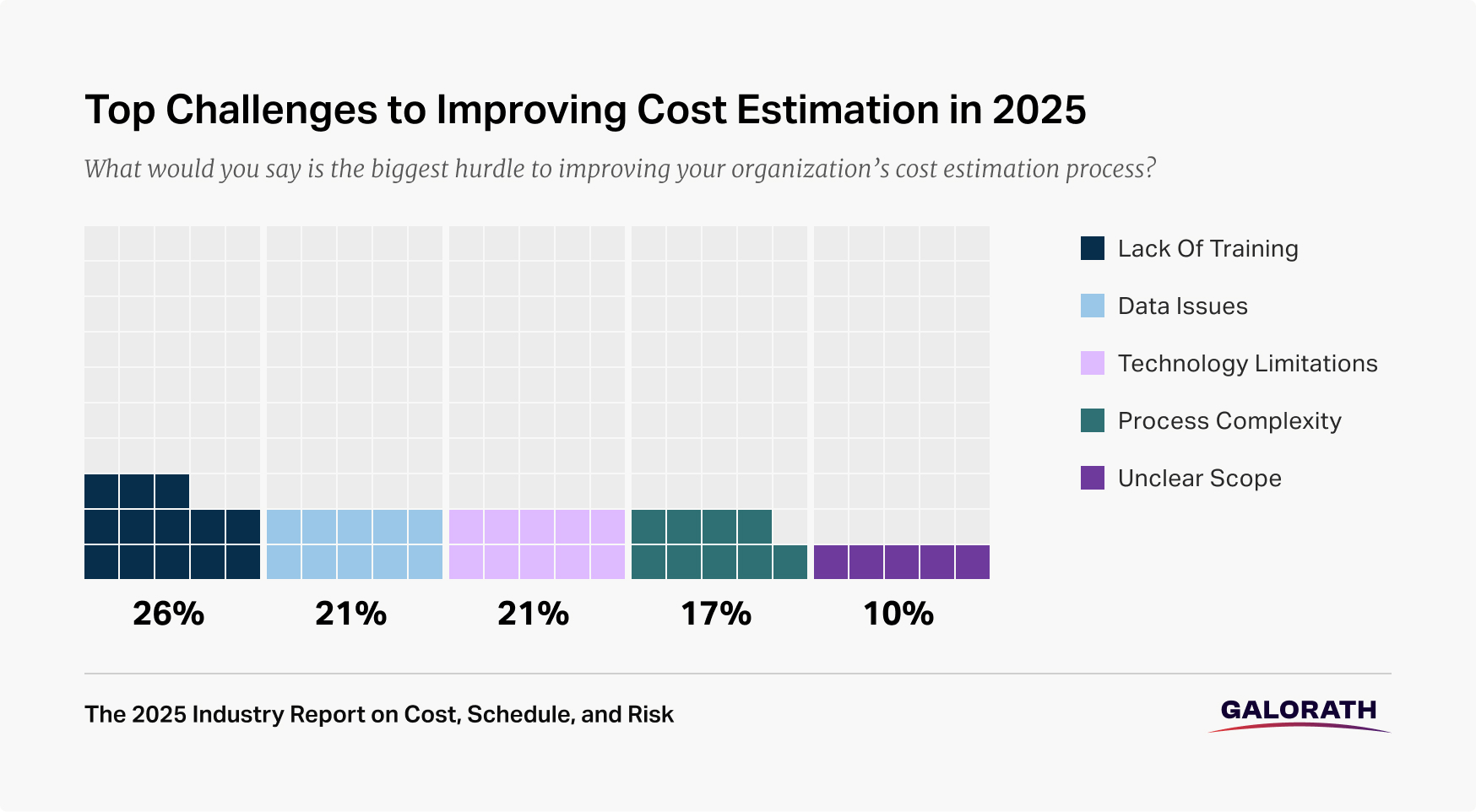
But behind these surface-level challenges lie deeper systemic and organizational issues. Here’s a comprehensive look at each challenge area, with added insights from government reports, industry surveys, and project management best practices.
Lack of Training and Enablement
The top barrier to improving cost estimation in 2025 is a lack of training and skills enablement. As AI, automation, and model-based estimation tools become more advanced, many teams are falling behind in their ability to apply them effectively. This creates a widening capability gap between available tools and actual user proficiency.
The result? Low confidence in cost estimates. In fact, only a small portion of respondents said they were “very confident” in their estimates, while over half admitted to being only “somewhat confident.”
Teams reported a lack of:
- Structured training courses tailored to cost estimation
- Accessible documentation or walkthroughs
- Mentorship or internal support
- Organizational ownership of learning strategy
This not only hampers productivity but increases the risk of poor estimates during early-stage planning—when accuracy matters most.
Data Issues and Poor Data Availability
Even the most skilled estimator can’t produce reliable forecasts without high-quality data. Many organizations struggle with:
- Incomplete or outdated historical cost records
- Inconsistent data formats across systems
- Fragmented databases that prevent holistic analysis
These issues undermine Cost Estimating Relationships (CERs) and weaken the analytical foundation for estimation. As identified by both the GAO and ICEAA, strong data hygiene is essential for developing defensible cost estimates.
Technology Limitations and Underutilized Tools
While digital estimation platforms are increasingly available, many organizations still depend on spreadsheets or legacy systems that lack scalability, integration, or auditability. Even when modern tools are deployed, they’re often underutilized due to:
- Poor onboarding
- Lack of ownership
- Inconsistent access or licensing
- Limited vendor support or documentation
This disconnect leads to missed opportunities in automating workflows, performing sensitivity analysis, and integrating estimates with digital engineering environments.
Process Complexity
Cost estimation is inherently complex, especially in large-scale or multi-phase projects. Teams must coordinate inputs from engineering, procurement, and finance—often with different assumptions, priorities, or metrics.
Additionally, the increasing use of digital twins and model-based engineering creates new challenges in aligning estimates with Work Breakdown Structures (WBS) or lifecycle frameworks.
This complexity can slow down estimates, obscure cost drivers, and make traceability more difficult.
Unclear Scope and Scope Creep
Uncertain or evolving scope remains one of the oldest and most persistent challenges in cost estimation. Without clearly defined requirements, cost assumptions quickly become obsolete, forcing rework and eroding stakeholder trust.
The GAO Cost Estimating and Assessment Guide flags incomplete technical baselines as a leading cause of cost estimation failures. When scope creep occurs—through added features, shifting goals, or changing stakeholder priorities—early estimates become unreliable.
Stakeholder Misalignment
Even with the right tools and data, misaligned stakeholders can derail estimation efforts. Competing incentives, budget constraints, or internal politics may lead to:
- Pressure to “make the numbers fit”
- Distorted assumptions or incomplete inputs
- Reduced transparency across departments
According to Birdview’s project management survey, cross-functional misalignment is one of the biggest threats to budget accuracy—particularly when estimates lack shared ownership or visibility.
Market Volatility and Inflation
External economic factors such as inflation, labor shortages, or material price swings can dramatically impact cost projections. Early-stage estimates that don’t include escalation modeling or indexing quickly lose relevance.
To combat this, cost models should integrate real-time market data and flexible economic scenarios. Unfortunately, many organizations still treat these risks as outliers instead of core estimation components.
Underestimated Risk and Lack of Contingency Planning
A common failure in both public and private sectors is insufficient contingency planning. When teams don’t adequately model risk, budgets are often underfunded and inflexible.
GAO audits repeatedly highlight underallocated reserves as a root cause of rebaselining events and cost overruns. Proper estimation must include:
- Sensitivity analysis
- Monte Carlo simulations
- Explicit risk ranges
- Contingency budgets based on uncertainty
Without these practices, estimates can give a false sense of precision that collapses under real-world change.
Tips and Best Practices for Accurate Project Cost Estimation
Achieving reliable project cost forecasts requires more than technical modeling; it demands disciplined processes, stakeholder alignment, and continuous refinement. Organizations that consistently deliver accurate estimates apply structured best practices adapted to their industry, project size, and data maturity.
1. Implement the GAO 12-Step Estimation Process
The GAO Cost Estimating and Assessment Guide provides a foundational framework for developing credible estimates. Key steps include defining the technical baseline, identifying cost drivers, documenting assumptions, conducting independent reviews, and validating against actuals.
2. Tailor to Industry-Specific Best Practices
Cost estimation must reflect domain-specific complexities:
- Software and IT: Use Agile-compatible methods like story points, function point analysis, and historical velocity tracking.
- Aerospace and Defense: Integrate Earned Value Management (EVM), technical performance metrics, and compliance with CSDR (Contractor Cost Data Reporting).
- Construction: Emphasize detailed Work Breakdown Structures (WBS), quantity takeoffs, and escalation modeling.
3. Establish Robust Quality Assurance Protocols
Validate estimates with benchmarking, range-based forecasts, and Monte Carlo simulations. Peer reviews and red team evaluations improve transparency and reduce bias. Maintain a comprehensive Basis of Estimate (BOE) to document inputs, assumptions, and rationale for traceability.
4. Engage Stakeholders Throughout the Estimation Lifecycle
Include cross-functional input from finance, engineering, procurement, and operations. Collaborative reviews ensure scope alignment, identify cost blind spots, and promote buy-in across stakeholders and sponsors.
5. Institutionalize Continuous Improvement
High-performing organizations track estimate vs. actual variance across projects, refine parametric models, and invest in estimator certification (e.g., AACE’s CCP, ICEAA’s CCEA). Lessons learned and feedback loops feed ongoing estimation process improvements.
How to Create a Project Cost Estimate: A Step-by-Step Guide
Creating a reliable project cost estimate isn’t about plugging numbers into a spreadsheet — it’s a structured, iterative process grounded in logic, data, and stakeholder alignment. Below is a comprehensive 12-step approach that aligns with GAO best practices and supports the demands of modern, complex project delivery.
Step 1: Define Scope and Technical Baseline
Estimation begins with clarity. Define the project’s scope, deliverables, and technical requirements using tools such as the Work Breakdown Structure (WBS). Whether you’re managing software, infrastructure, or hardware programs, this ensures a shared understanding of what’s included — and just as importantly, what isn’t.
- Tip: Include assumptions, constraints, and exclusions.
- Output: Scope Statement, System Requirements, Initial WBS
Step 2: Identify Cost Drivers and Select Estimation Methods
Once the scope is known, identify key cost drivers — the elements that most significantly affect project cost (e.g., labor hours, materials, integration complexity). Then, select the right estimation methodology:
- Analogous for early-phase or high-level comparisons
- Bottom-up for detailed estimates using specific tasks and resources
- Parametric for scalable estimates using models and cost estimating relationships (CERs)
- Output: Selected methodology and list of primary cost drivers
Step 3: Collect and Validate Historical Data
Historical data fuels accurate forecasts. Gather internal data from previous projects or pull benchmarks from third-party sources, vendors, or industry databases. Validate this data for relevance and consistency.
- Include: Productivity rates, vendor quotes, material prices, previous actuals
- Tip: Adjust historical data for inflation, complexity, or scale
- Output: Verified, normalized data set ready for estimation inputs
Step 4: Develop Preliminary Estimates
Using the selected methods and data, create conceptual or Rough Order of Magnitude (ROM) estimates. These provide directional guidance to assess feasibility and affordability in the early stages.
- Use expert judgment when detailed data is limited
- Maintain transparency about confidence levels and limitations
- Output: ROM Estimate or Top-Down Budget Range
Step 5: Conduct Risk and Sensitivity Analysis
No estimate is complete without understanding uncertainty. Perform risk and sensitivity analyses to model variable ranges and dependencies. Techniques like Monte Carlo simulation help quantify probability distributions and confidence intervals.
- Identify high-risk inputs and evaluate how they influence total cost
- Output: Sensitivity Charts, Risk Range Estimates, Contingency Inputs
Step 6: Apply Contingency and Risk Reserves
Translate risk findings into a defensible contingency reserve. Avoid generic percentage-based buffers — instead, use data-driven, risk-adjusted values tied to severity and likelihood.
- Apply contingency at the appropriate WBS level
- Document basis for reserve decisions
- Output: Contingency Reserve, Risk Register
Step 7: Calibrate Estimates Through Peer and SME Review
Bring in subject matter experts (SMEs) and independent reviewers to challenge assumptions, cross-check methodologies, and refine estimates. This step helps eliminate bias and improves estimate credibility.
- Encourage open challenge sessions or red team reviews
- Output: Validated, peer-reviewed estimate
Step 8: Decompose into Control Account Estimates
Break the estimate into Control Accounts or Cost Accounts, aligned with your WBS and project control framework. This step enables accurate tracking of costs, performance, and variances during execution.
- Tie estimates to resources, deliverables, and cost elements
- Prepare for Earned Value Management (EVM) if required
- Output: Control Account Dictionary, Resource Breakdown Structure
Step 9: Integrate with Schedule and Procurement Planning
Ensure the estimate aligns with project timelines and procurement plans. Costs must be time-phased — distributed across the calendar or project lifecycle — to match funding needs, contract milestones, and resource availability.
- Coordinate with schedulers and procurement officers
- Output: Time-Phased Cost Estimate, Funding Profile
Step 10: Document the Basis of Estimate (BOE)
Prepare a comprehensive Basis of Estimate (BOE). This audit-ready document details the sources, assumptions, estimation logic, and caveats. It also explains which methods were used and why.
- Include: Inflation indices, exchange rates, sourcing strategy, and escalation assumptions
- Output: BOE Package (often required for government proposals)
Step 11: Review, Approve, and Baseline the Estimate
Present the final estimate for formal approval. Stakeholders validate alignment with goals, budget thresholds, and risk tolerance. Once approved, the estimate is baselined — becoming the official cost benchmark for performance tracking.
- Consider establishing thresholds for re-baselining
- Output: Approved Cost Baseline, Budget Authorization
Step 12: Monitor, Reforecast, and Update
Estimation doesn’t end at project kickoff. As execution unfolds, track actuals vs. estimates, and continuously monitor variances. Use metrics like Cost Performance Index (CPI) or Estimate at Completion (EAC) to detect deviations early.
Update forecasts regularly and communicate impact
Learn from actuals to improve future estimates
Output: Forecast Reports, Change Logs, Lessons Learned
Industry-Specific Project Cost Estimation Examples
Project cost estimation practices vary significantly across industries due to domain-specific requirements, risk factors, and data maturity. This section outlines estimation methodologies, tools, and performance insights across three high-impact sectors: IT, software development, and manufacturing.
IT Project Cost Estimation
Cost estimation for IT infrastructure and service projects often involves rapidly evolving technology, cloud-based architectures, and third-party dependencies.
- Key Components: Software licenses, cloud infrastructure (IaaS/PaaS), systems integration.
- Estimation Techniques:
- Early-phase: Function Point Analysis (FPA), Story Point sizing, analogous estimates.
- Later phase: Bottom-up costing using configuration and deployment plans.
- Early-phase: Function Point Analysis (FPA), Story Point sizing, analogous estimates.
- Tools and Technology:
- Cloud-native forecasting platforms (e.g., AWS Cost Explorer, Azure Cost Management).
- ML-enhanced cost prediction models using historical consumption data.
- Cloud-native forecasting platforms (e.g., AWS Cost Explorer, Azure Cost Management).
- KPI Focus: Burn Rate, Estimate to Complete (ETC), Variance from Forecast.
- Lesson Learned: Agile-aligned estimation models tied to sprint velocity consistently improve accuracy and support early detection of scope creep.
Software Project Cost Estimation
Software development combines rapid iteration with long-term scalability needs. Estimation accuracy depends on integrating agile metrics with parametric techniques.
- Scope: Application features, architecture complexity, third-party components.
- Approach:
- Agile teams: Use story point–based velocity and cost per sprint.
- Traditional: Apply WBS with function points or use-case sizing.
- Hybrid models: Calibrate productivity baselines (e.g., $100/FP at 5 FP/day) with actual delivery metrics.
- Agile teams: Use story point–based velocity and cost per sprint.
- Tools: SEER-SEM, CostX for code estimation, Jira integration for sprint velocity tracking.
- KPI Focus: Story Point Cost, Cost per Feature, Schedule Adherence.
- Lesson Learned: Hybrid models combining parametric and empirical metrics improve cost predictability in projects with shifting requirements.
Manufacturing Cost Estimation
Manufacturing projects emphasize precision in materials, labor, and production overhead. Estimates support both unit-costing and total lifecycle financial planning.
- Key Cost Elements: Bill of Materials (BOM), direct labor hours, tooling amortization, overhead rates.
- Methods:
- Parametric estimation based on units of output.
- Activity-Based Costing (ABC) for overhead allocation.
- ML models trained on historical runs to predict material usage and scrap rates.
- Parametric estimation based on units of output.
- Tools: BIM-linked takeoff tools, ERP-integrated cost platforms, simulation-based estimators.
- KPI Focus: Cost per Unit, Scrap Rate, Estimate Accuracy Variance.
- Lesson Learned: Implementing BIM-driven quantity takeoffs with predictive analytics has led to a 25–30% reduction in estimate-to-actual variance.
Cross-Industry Comparison
| Industry | Core KPI Focus | Emerging Technology Integration |
| IT | Burn Rate, Sprint Forecasting | AI-driven cloud cost modeling, agile backlogs |
| Software | Story Point Cost, Velocity | Hybrid parametric–agile estimation, SEER-SEM |
| Manufacturing | Unit Cost, Variance Tracking | BIM-integrated costing, predictive analytics |
Strategic Insight: While methods differ, all sectors benefit from aligning estimates with scope definition maturity (AACE Class 3–1) and reinforcing estimation accuracy through post-project benchmarking. Integrating domain-specific KPIs with digital estimation tools enhances transparency, control, and long-term cost performance.
Cost estimation is a strategic project capability grounded in structured methodologies, data-driven tools, and lifecycle financial discipline. It informs planning, enhances control, and reinforces stakeholder confidence across industries. Accurate estimation is never isolated; it integrates with risk management, procurement, and scheduling to support successful execution and long-term value delivery. Organizations that prioritize estimation maturity gain not only budgeting precision but also a competitive edge in project delivery outcomes.
Cost Estimating in Agile vs. Waterfall Environments
Cost estimation is not one-size-fits-all, and the approach must adapt depending on the project delivery methodology. The differences between Waterfall and Agile environments significantly influence how cost estimates are created, refined, and managed throughout the lifecycle.
Cost Estimating in Waterfall Projects
In traditional Waterfall methodologies, cost estimation follows a linear process. Estimates are often developed early in the planning phase, once requirements are well defined. Teams typically:
- Use Work Breakdown Structures (WBS) to scope and allocate costs
- Apply bottom-up or parametric models to individual tasks
- Set a fixed cost baseline that serves as the benchmark for tracking
While this approach supports detailed, high-confidence estimates, it requires stable scope and minimal change. Any scope evolution often triggers re-estimation or rebaselining events.
Cost Estimating in Agile Projects
In contrast, Agile cost estimation is iterative and adaptive. Since scope evolves sprint by sprint, so too must the cost estimate. Agile teams focus on:
- Relative estimation units, such as story points or t-shirt sizing
- Tracking burn rate (cost per sprint) and velocity (story points completed)
- Creating rolling forecasts rather than fixed budgets
Instead of setting a single, upfront estimate, Agile teams refine cost predictions as backlogs evolve and delivery patterns become clearer. Techniques such as cone of uncertainty, epics-to-cost mapping, and Monte Carlo simulation help forecast cumulative costs over time.
Key Differences at a Glance
| Feature | Waterfall | Agile |
|---|---|---|
| Scope Definition | Fixed, defined upfront | Evolving, incremental |
| Estimating Method | WBS-based, detailed | Backlog-based, iterative |
| Forecast Type | Single-point baseline | Rolling forecast |
| Metrics Used | EAC, CPI, CV | Burn Rate, Velocity, ETC |
| Reforecasting | Triggered by change | Continuous, sprint-based |
Frequently Asked Questions about Cost Estimating
What makes a cost estimate “credible”?
A credible estimate is comprehensive, well-documented, accurate, and validated by subject matter experts. It includes uncertainty analysis, uses reliable data sources, and is traceable to assumptions and methodologies
What’s the most common reason cost estimates fail?
The most frequent reason is unclear scope or requirements. Without a well-defined baseline, cost assumptions quickly become outdated or inaccurate, leading to rework, scope creep, and overruns.
How are cost estimates different from budgets?
A cost estimate is a forecast of expected costs based on known information. A budget is the approved funding allocation, which includes constraints, reserves, and strategic considerations. Estimates inform budgets but are not the same.
What’s the role of risk in cost estimating?
Risk analysis is essential, because it helps determine appropriate contingencies and improves confidence in the estimate. Without modeling uncertainty, estimates can appear precise but lack realism.
How does SEER handle cost estimation for projects with limited historical data?
SEER offers robust parametric models and knowledge bases that help generate reliable estimates even when historical data is scarce. Users can start with industry benchmarks or similar system analogs and refine estimates as more data becomes available.
Is SEER suitable for government or defense project cost estimation?
Absolutely. SEER is widely used in defense and government programs, supporting requirements like CSDR compliance, lifecycle cost analysis, and earned value management (EVM). It aligns with standards from agencies such as GAO and DoD.
Can SEER help estimate post-deployment or sustainment (O&S) costs?
Yes. SEER includes features for Operating and Support (O&S) cost estimation, allowing users to model long-term sustainment, maintenance, training, and disposal costs — critical for total lifecycle planning.
Does SEER integrate with scheduling or project management tools?
Yes. SEER integrates with platforms like Microsoft Project, Primavera, and other PPM tools to align cost estimates with schedules, milestones, and resource plans, ensuring consistency across disciplines.
How does SEER support estimate traceability and audit readiness?
SEER automatically documents all assumptions, inputs, and estimation logic, generating a detailed Basis of Estimate (BOE). This makes it easy to trace, review, and defend estimates during audits or stakeholder reviews.