
10-Step Estimation Process Checklist
View our 10 Step Estimating Process Checklist. This checklist should be tuned to the individual company’s needs and suggestions.
The EU has pushed its high-risk AI deadline from August 2026 to December 2027. The reprieve resets the regulatory calendar, yet the ungoverned AI already shaping cost estimates inside most organizations answers to no calendar at all.
For most of the past year, the EU AI Act gave compliance teams a hard date to organize around: August 2, 2026, when the full obligations for high-risk systems were set to take force. That date has now moved. Under the Digital Omnibus, European negotiators reached a provisional agreement to defer the stand-alone high-risk requirements of Annex III to December 2, 2027, with penalties for noncompliance still reaching as high as 15 million euros or 3% of global turnover. Cost and resource estimation that drives consequential funding and bid decisions sits inside that high-risk category, which means the forcing function many organizations were counting on just slid sixteen months to the right.
A deadline that has slipped sixteen months tends to slide down the priority list along with it, and that is the danger. The August date supplied a convenient external reason to act. Removing it changes nothing about the problem underneath, which was never about the calendar. By one estimate, roughly 80% of Fortune 500 companies have lost a clear view of where AI runs within their operations, and security researchers report that close to half of generative AI users now access these tools through unmanaged personal accounts that bypass corporate data controls. None of that paused while Brussels revised its timetable.
Picture an analyst dropping a work breakdown structure or a vendor quote into a general-purpose chatbot and asking for a defensible cost range. The tool returns something fluent and specific within seconds, yet it cannot show where the figure came from, which historical programs informed it, or how to reproduce it under review. A cost figure carries an authority all its own, and an authoritative figure with no traceable basis is the most dangerous object in our discipline. Unlike a flawed weld, which inspection catches, a flawed estimate can pass through a milestone review unnoticed and surface months later, when someone asks how the number was derived and finds no answer.
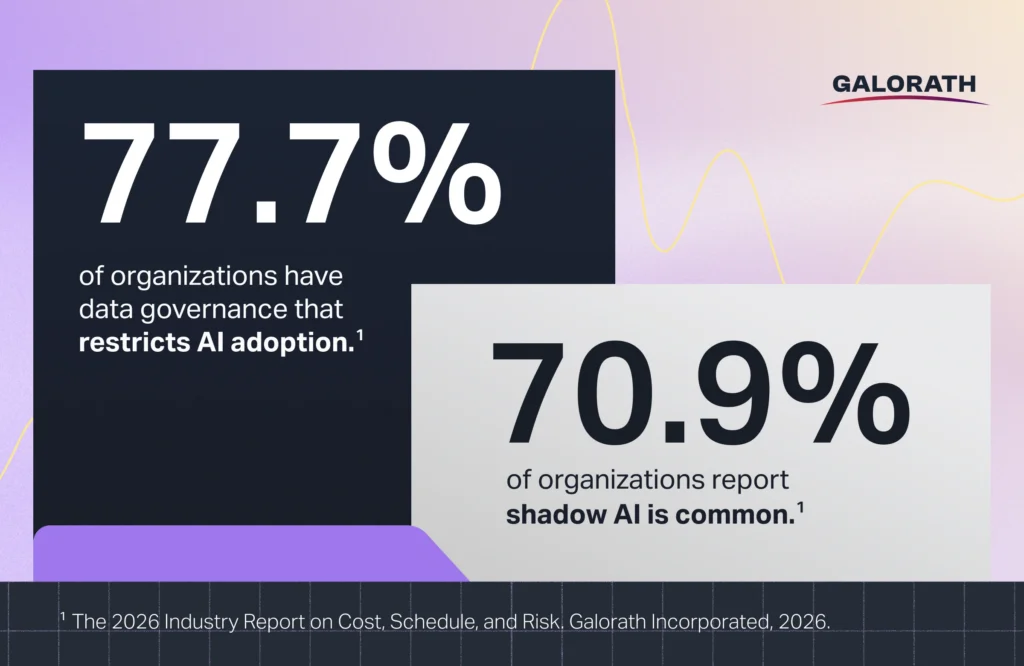
Galorath’s 2026 State of the Industry report measures how far this has spread, and its verdict on enterprise AI is blunt: the governance framework is broken. The research found that 77.7% of organizations maintain data governance restrictions meant to limit AI use, while 70.9% report that shadow AI, the informal and ungoverned kind, has already become common in daily work. Documented AI policies exist in only 23.6% of them, and fewer than one in five describe themselves as ready to govern AI-based decisions within their regulatory environment. The report ties the problem straight to execution, warning that shadow AI undermines the reliability of the estimates an organization depends on. Multiply one ungoverned query across the hundreds of analysts a large program employs, and the estimating baseline starts to rest on figures that cannot be sourced, compared, or defended.
Telling analysts to abandon AI is a directive that collapses under deadline pressure, since the tools genuinely shorten the work. The durable response is to give estimators AI built for governance from the first design decision, so the sanctioned route becomes the fastest one. This is the gap Galorath built SEERai to close. SEERai is the Estimation-Centric AI layer of the SEER platform, and what separates it from a consumer chatbot is architectural. Its outputs trace back to validated historical and operational data inside the SEER modeling core, so every generated range can be traced to that data and the assumptions behind it. The approach Galorath calls Estimation-Centric AI rests on five principles. Task specialization, data control, explainability, human oversight, and secure integration each answer a question an auditor or a contracting officer now puts on the table. SEERai runs inside an isolated-tenant environment that can deploy on-premises, in private cloud, or fully air-gapped, with actions logged and every output reviewable against the inputs that produced it. Adopting it converts the exposure that shadow AI creates into a capability leadership can stand behind, because each estimate arrives already sourced, logged, and ready for review.
Someone will eventually ask your organization to produce a complete account of every AI system that has touched a cost estimate, a bid, or a budget justification. The request may carry the authority of a European regulator in December 2027, or it may arrive far sooner from a program auditor or a customer’s contracting officer. That answer grows far easier to give when the AI doing the estimating was governed from the start. Estimates are already being produced with AI inside most organizations. What leadership still controls is whether that work happens somewhere it can see, audit, and defend, with or without a deadline forcing the question.
10-Step Estimation Process Checklist
View our 10 Step Estimating Process Checklist. This checklist should be tuned to the individual company’s needs and suggestions.

Estimating Total Cost of Ownership (TCO)
Find out how you can use Total Cost of Ownership (TCO) model to create an estimate which includes all the costs generated over the useful life of a given application.

Should Cost Analysis
Learn how Should-Cost Analysis can identify savings opportunities and drive cost efficiency in procurement and manufacturing processes.
ROM Estimate: The First Step Towards a Detailed Project Plan
Find out what ROM (rough order of magnitude) estimate is and why is it a crucial element of every project planning cycle.
Software Maintenance Cost
Find out why accurate estimation of software maintenance costs is critical to proper project management, and how it can make up to roughly 75% of the TCO.

 Add Galorath as a preferred source on Google

Share this:


Get access to news
Sign up to get relevant news in your inbox - never miss it!