
2026 STATE OF THE INDUSTRY — HEALTHCARE
The Regulated Innovator: Shadow AI Meets Compliance Reality
Organizations enter 2026 with more data, more tools, and more visibility than ever, yet they struggle to translate that into reliable plans.

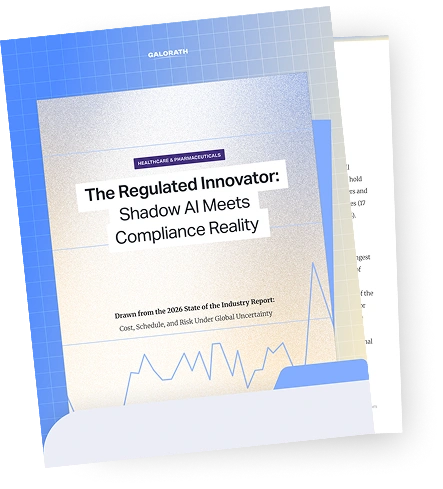
- Vertical-specific data & benchmarks
- Tailored implications for your industry
- Read in ~10 minutes
- Easy to share internally
One sign-up, free access to the report and all 15 briefs
One full report and analysis.
15 segment briefs.
The full report offers insights and analysis into global cost, schedule, and risk trends, from AI to parametric modeling. 15 segment briefs provide deep dives into a single industry, region, and functions.
2026 REPORT
The Governance Imperative: Cost,
Schedule, and Risk Under Global Uncertainty
15 Segment Briefs
- IT & Software Development
- Manufacturing
- Transportation & Logistics
- Healthcare & Pharmaceuticals
- Energy & Utilities
- Automotive Manufacturing
- Aerospace & Defense
- AI Adoption & Governance
- European Union
- United Kingdom
- North America
- Australasia
- Engineering & Tech Leaders
- Finance & Procurement Leaders
- Program & Ops Leaders
SEGMENT EXCERPT
Segment Snapshot
Healthcare and Pharmaceuticals respondents (n=37, representing 16.8% of the overall sample) demonstrate a distinctive organizational profile. Two-thirds of respondents hold senior leadership positions (67.6%), with the remainder distributed across practitioners and middle managers (32.4%). Geographically, the sample concentrates in the United States (17 respondents), with smaller contingents from Germany (5) and the United Kingdom (3). Functionally, Finance executives and Senior Managers of Operations predominate, reflecting the cost estimation and operations planning focus of this analysis.
Healthcare is defined by a striking organizational paradox. The sector reports the strongest centralized governance clarity in the survey (45.9% vs. 31.8% overall)—a direct legacy of decades of HIPAA compliance, FDA regulatory frameworks, and Good Manufacturing Practice (GxP) standards. Yet alongside this institutional governance strength sits one of the highest rates of informal AI experimentation across the sample (35.1% report informal or individual experimentation). This is not a sector without controls; rather, it is one where formal governance and informal experimentation operate in parallel. Practitioners innovate around the edges of compliance frameworks, often without formal organizational approval—a active that reflects both the pace of AI change and the perceived speed of formal governance processes.
Table of Contents
1 of 6 unlockedSegment Snapshot
Healthcare and Pharmaceuticals respondents (n=37, representing 16.8% of the overall sample) demonstrate a distinctive organizational profile. Two-thirds of respondents hold senior leadership positions (67.6%), with the remainder distributed across practitioners and middle managers (32.4%). Geographically, the sample concentrates in the United States (17 respondents), with smaller contingents from Germany (5) and the United Kingdom (3). Functionally, Finance executives and Senior Managers of Operations predominate, reflecting the cost estimation and operations planning focus of this analysis.
Healthcare is defined by a striking organizational paradox. The sector reports the strongest centralized governance clarity in the survey (45.9% vs. 31.8% overall)—a direct legacy of decades of HIPAA compliance, FDA regulatory frameworks, and Good Manufacturing Practice (GxP) standards. Yet alongside this institutional governance strength sits one of the highest rates of informal AI experimentation across the sample (35.1% report informal or individual experimentation). This is not a sector without controls; rather, it is one where formal governance and informal experimentation operate in parallel. Practitioners innovate around the edges of compliance frameworks, often without formal organizational approval—a active that reflects both the pace of AI change and the perceived speed of formal governance processes.

 Your information is secure and will never be sold.