
2026 STATE OF THE INDUSTRY — AUTOMOTIVE
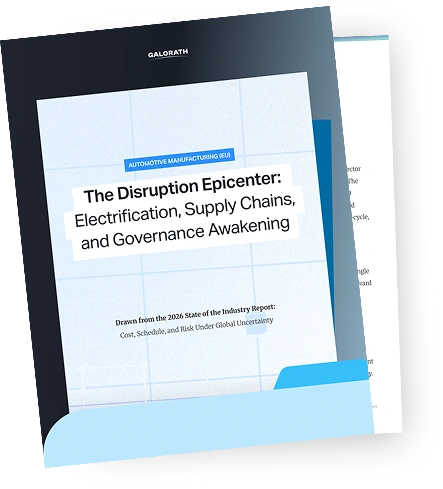
The Disruption Epicenter: Electrification, Supply Chains, and Governance Awakening
Organizations enter 2026 with more data, more tools, and more visibility than ever, yet they struggle to translate that into reliable plans.

- Vertical-specific data & benchmarks
- Tailored implications for your industry
- Read in ~10 minutes
- Easy to share internally
One sign-up, free access to the report and all 15 briefs
One full report and analysis.
15 segment briefs.
The full report offers insights and analysis into global cost, schedule, and risk trends, from AI to parametric modeling. 15 segment briefs provide deep dives into a single industry, region, and functions.
2026 REPORT
The Governance Imperative: Cost,
Schedule, and Risk Under Global Uncertainty
15 Segment Briefs
- IT & Software Development
- Manufacturing
- Transportation & Logistics
- Healthcare & Pharmaceuticals
- Energy & Utilities
- Automotive Manufacturing
- Aerospace & Defense
- AI Adoption & Governance
- European Union
- United Kingdom
- North America
- Australasia
- Engineering & Tech Leaders
- Finance & Procurement Leaders
- Program & Ops Leaders
SEGMENT EXCERPT
Segment Snapshot
Seniority distribution in Automotive Manufacturing reflects exceptionally high leadership concentration: 84.6% occupy leadership roles, while only 15.4% are individual contributors. This skew toward senior perspectives provides valuable strategic insights but may under-represent operational and tactical viewpoints.
Geographic distribution is overwhelmingly European. Germany accounts for six respondents, France for three, and the United Kingdom for two. This regional concentration reflects the current center of gravity for Automotive transformation across the surveyed markets.
Role distribution includes senior operations managers (3), finance executives (2), and specialists across supply chain, engineering, and IT leadership. This mix reflects the broad stakeholder engagement required for industry transformation.
Automotive Manufacturing shows the most extreme divergence of any industry segment examined in this survey. These outliers reflect an industry undergoing concurrent structural transformation—electrification, supply chain reconfiguration, regulatory reform, and workforce redeployment occurring simultaneously. The industry is not experiencing normal cyclical volatility; it is rewriting fundamental business models.
Table of Contents
1 of 6 unlockedSegment Snapshot
Seniority distribution in Automotive Manufacturing reflects exceptionally high leadership concentration: 84.6% occupy leadership roles, while only 15.4% are individual contributors. This skew toward senior perspectives provides valuable strategic insights but may under-represent operational and tactical viewpoints.
Geographic distribution is overwhelmingly European. Germany accounts for six respondents, France for three, and the United Kingdom for two. This regional concentration reflects the current center of gravity for Automotive transformation across the surveyed markets.
Role distribution includes senior operations managers (3), finance executives (2), and specialists across supply chain, engineering, and IT leadership. This mix reflects the broad stakeholder engagement required for industry transformation.
Automotive Manufacturing shows the most extreme divergence of any industry segment examined in this survey. These outliers reflect an industry undergoing concurrent structural transformation—electrification, supply chain reconfiguration, regulatory reform, and workforce redeployment occurring simultaneously. The industry is not experiencing normal cyclical volatility; it is rewriting fundamental business models.

 Your information is secure and will never be sold.